-->
Showing posts with label Aviation History. Show all posts

Wednesday, October 2, 2013

Today at KBDR

Early this morning the bright sun was shining at Sikorsky Memorial Airport (KBDR) and warming the old aluminum bones of some visiting veterans. The 2013 Wings of Freedom tour of WW II aircraft maintained and flown by the Collings Foundation was again in town. The Boeing B-17G Flying Fortress "Nine O Nine", the Consolidated B-24J Liberator "Witchcraft", and the North American P-51C Mustang "Betty Jane" were waiting quietly on the ramp for the day's visitors and admirers.

We are fortunate that there are dedicated men and women who work very hard to keep these old birds flying, helping us to honor the memories of those who went to war in them. And so, a few words about each of these wonderful machines and about their old namesakes...

The original "Nine-O-Nine" was a 91st Bomb Group, 323rd Squadron aircraft that completed 140 missions in Europe without an abort or loss of a crewman.

Today's airplane, s/n 44-83575, was license-built by Douglas Aircraft in Long Beach, CA and was accepted by the USAAF on 7 April 1945 – making her 68 years old. Born too late to see combat, she served as an air/sea rescue aircraft and as a transport. Sold into civilian life, she worked for two decades as a fire-fighting aircraft and then was restored to wartime configuration. A serious accident led to a second restoration, but since then she's logged over 1,200 tour stops. Since the unfortunate loss of "Liberty Belle" in 2011, "Nine O Nine" is one of only ten airworthy B-17's in the world.

The original “Witchcraft” was a B-24H, built at Ford's Willow Run plant in Michigan in 1944. She began combat service on April 10th, 1944, flying the first combat mission of the 467th Bomb Group. Over the next year “Witchcraft” flew 130 combat missions, never turned back from a mission, and never had any crewmen injured or killed. Her last mission was flown on April 25th, 1945.

The airplane we see today is B-24J s/n 44-44052. She was delivered from the Consolidated Aircraft Company's Fort Worth, Texas plant in August 1944, 69 years ago. In October of 1944, she was transferred to the Royal Air Force and saw combat in the Pacific Theater. At war's end, the aircraft was abandoned in Khanpur, India, never expected to fly again. However, in 1948 the Indian Air Force succeeded in restoring 36 B-24's, including this one, to operational status – and thereby hangs a tale.

These B-24's served the IAF until 1968 and then were abandoned. 44-44052 spent 13 years in derelict condition until she was discovered by a collector, shipped to England and ultimately acquired and restored by the Collings Foundation. Today she is the only airworthy B-24J and one of only two flying B-24's (the other is a B-24A).

The P-51C that carried s/n 42-103293 was built by North American at its Dallas plant in 1943. That aircraft went to England where it flew for the 370th Fighter Squadron, 359th Fighter Group. There, it suffered substantial damage in a training accident (search on the s/n HERE) in which Capt. Carey H. Brown, Jr. of Monroe, NY was killed. The aircraft was written off on 3 May 1944 and sent to the scrap heap.

After many years, significant parts of the airframe were recovered by a professional aircraft restorer – including the data plate. This allowed the resurrection of 42-103293. When the aircraft was rebuilt in 2002 and 2003 it was completed as a 2 seat version, a TP-51C. This field modification added a second seat with flight controls and instrumentation for training purposes. (At least 5 TP-51Cs were built during WWII for training and VIP transport.)

This Mustang is painted as Col. Charles M. McCorkle's "Betty Jane", that he flew as commander of the 31st Fighter Group in the Mediterranean Theater. Col. McCorkle had 11 confirmed kills, six in the Mustang. After the war, he rose to the rank of Major General, retiring in 1966. He went West in 2009.

Col. Charles M. "Sandy" McCorkle in the cockpit of his Mustang

Wednesday, June 5, 2013

Book Review: "Gyro! The Life and Times of Lawrence Sperry" by William W. Davenport

It has been my practice to confine book review posts to books that I would recommend to a friend as being enjoyable or instructive – or, preferably, both. In that light, the book I'm about to discuss, William Wyatt Davenport's Gyro! The Life and Times of Lawrence Sperry, is troubling. It does indeed present an enjoyable story. And, reading it does prove instructive...but not in the way one usually hopes. The lesson of the book is that some biographies may be works of fiction clad in a thin layer of verisimilitude, and that a healthy skepticism is a useful tool for the reader of history.

I wanted to learn more about Lawrence Sperry, as the stories commonly told about his brief and colorful life consistently rendered him as a fascinating character. What better approach, thought I, than to lay hands on a copy of his biography? This was readily accomplished with the aid of a used book vendor, facilitated by the good folks at Amazon.com. But very soon after opening the book I encountered a warning sign. What does one make of a biographer who, in the Acknowledgements at the front of the work, says this:
"As in every life that has been lived to the hilt, there are hiatuses, documents that have been lost or suppressed, the ambiguities of reality, questions that have not been answered, problems that have not been solved. In such cases, in my attempt to gather up the radiance of a dynamic personality, I have been authorized to indulge in some judicious speculation and have occasionally asserted poetic truths where actual facts were missing." (emphasis added)

I had to read that twice. It took a while for the realization to solidify that the author was saying, "When I didn't have solid evidence to tell the subject's story, I just made stuff up." Really? At this point I went directly to the back of the volume where I found no list of sources and no end notes...just a somewhat sparse index. The conclusion became obvious: nothing in this book can be trusted. Any assertion made by the author is just as likely to be a "poetic truth" as an "actual fact".

Lawrence Burst Sperry deserved better than this.

Some examples illustrate the scope of the problem. The book tells a tale (one can't say "the tale") of the development of the gyro-stabilizer (precursor of the autopilot) for use in aircraft. It would have you believe that Lawrence, with minimal involvement of his father, the noted engineer Elmer A. Sperry, designed, developed and demonstrated the apparatus completely on his own. His native genius is depicted as a perfect substitute for the engineering education he regarded as unnecessary. But other sources cast doubt on this charming narrative.

A biographical memoir on Elmer A. Sperry by J.C. Hunsaker (published in 1954 by the National Academy of Sciences) has this to say:

"As (Elmer) Sperry was tied up with...other activities, he called in his friend Hannibal C. Ford, an extremely clever designer of intricate apparatus. Ford and Sperry together started on the design of a gyro compass... As a sideline they designed a small gyro stabilizer for an airplane..."
This was in 1910. Hunsaker goes on to say:
"In 1913 conditions seemed ripe for resuming the airplane
stabilizer work started but discontinued in 1910. Sperry knew Glenn Curtiss at the Aero Club in New York, got in touch
with him, and arranged to send his son Lawrence to Curtiss's shop at Hammondsport. Lawrence Sperry had already built
and flown his own airplane and later was awarded F.A.I. Pilot's License No. 11.

The Aero Club of France announced an international competition for a safe airplane with a prize of 50,000 francs to be awarded to the winner. Curtiss, in whose flying boat the gyro stabilizer had been tested, persuaded Sperry to send Lawrence to Paris to compete for the prize. The demonstration flight was made in June 1914.

As the plane flew low past the judges' stand the mechanic climbed out on the wing and Lawrence stood up in the open
cockpit raising both hands above his head. This was indeed convincing; nothing like it had ever been seen before. He won the prize."

The patent application for the airplane stabilizer was filed on 17 July 1914 and led to the issuance of US patent 1,368,226. The sole inventor named on the patent is Elmer A. Sperry. In addition, the work to develop the airplane stabilizer was honored with the award of the prestigious Collier Trophy for 1914. One name is engraved on the trophy for that year – that of Elmer A. Sperry.

Was Lawrence involved in, and important to, the project? Most certainly. Was he the driving force behind it? It would seem not.

Another example revolves around the origins of the aircraft type most often associated with Lawrence Sperry – and the one that eventually took his life. Known most commonly as the Sperry Messenger, it got its start in life, according to the author, when:

"Billy Mitchell...wanted an inexpensive, maneuverable little single-seat plane that the Army could use as a training ship for pursuit aviation. This coincided precisely with Lawrence's desire for a single-seater sports plane. He went to his drawing board and designed a small biplane whose lower wing was almost unnoticeable. Delighted with the design, Billy Mitchell ordered three of the planes, the first sports plane in American aviation, for the War Department. This plane was the famous Sperry Messenger; it was Billy Mitchell who gave it it's name." (Emphasis added.)
But other sources tell a different tale. For example, K.O. Eckland's authoritative Aerofiles site says:
"M-1 Messenger, M-1A, MAT (Verville-Sperry) 1920 = Army liaison and utility. Designed at McCook Field by Alfred Verville; aka Engineering Division M-1. Ailerons on all wings. POP: 22 as military M-1 and 20 as M-1A, plus 1 civil sport version that failed to spark any public interest, and the idea was never pursued."
Did Lawrence Sperry go "to his drawing board" and give birth to the Messenger? He absolutely did not. The talented Alfred Verville, working for the Army, designed the airplane and the Lawrence B. Sperry Airplane Co. was then hired to build it. (The Smithsonian, by the way, agrees.)

There are other statements at variance with accepted facts throughout the book. The text includes many instances of direct quotes from conversations where only two people were present and no record could have been made. More of those "poetic truths", I suppose.

The question I'm left with is, "Why?" To what end does the author steal the glory of Elmer Sperry, Alfred Verville and others and assign it to Lawrence Sperry? He had plenty of his own glory as the legitimate inventor of the life-saving gyroscopic turn-and-bank indicator (see US 1,433,102), as developer of major improvements in pack parachutes for pilots, as a central part of the project that developed the first "cruise missile", as a renowned aviator and proselytizer for flying in its early days. And yes, even as the spiritual founder of the Mile High Club (with essential assistance from Mrs. Waldo Polk). Why would the author risk his credibility, with all of this to work with?

Perhaps the clue lies in the use (seen above, in the quoted segment about "speculation" and "poetic truths") of the word authorized. I'd suggest that the author was not free to write his own book. Someone else had to be considered and satisfied. The story that was told had to be, at the end of the day, the authorized version. What a shame.

If you want to learn about Lawrence B. Sperry, go ahead and read this book. Then verify anything of particular interest through other credible sources. That's the only way you'll sieve out the "actual facts" and leave behind the "poetic truths."

Wednesday, February 6, 2013

Book Review: "A Higher Call" by Adam Makos

Charlie Brown was perfectly clear about the situation. When the young journalist, having "heard a story", sought him out for an interview, he said, "If you really want to learn the whole story, learn about Franz Stigler first...in this story, I'm just a character – Franz Stigler is the real hero."

Author Adam Makos had no choice but to seek out Franz Stigler, living in pleasant retirement in the Vancouver area, to learn what happened on 20 December 1943, in the skies near Bremen. There, the life arcs of two warrior-aviators intersected for about 10 minutes. If someone had described to their earlier selves what transpired during that brief encounter, they would each have reacted with disbelief. But as they moved on along separate paths – destined to intersect again nearly 50 years later – they knew their lives had changed forever.

On that morning over Germany, Charlie Brown was the 21 year-old pilot of a terribly damaged B-17. He was embarked on a first combat mission that had become deadly and terrifying. Franz Stigler was, at 28 years of age, an elite Luftwaffe veteran of hundreds of missions in the Bf 109. He was fighting to defend his homeland and his countrymen from the onslaught of the American bombers. Both of them had already on that day displayed heroism in battle. But when they met, there was nothing left for Charlie to do. Keeping his crew alive and his airplane aloft to that point had exhausted his resources. He could only watch and wait.

As he approached the straggling bomber, it fell to Franz Stigler to make a choice. The action required by the call of duty was clear. He should attack and destroy the wounded B-17. But perhaps there was a higher call, requiring forbearance. Perhaps honor and humanity required staying the hand of destruction. It was time to decide. Act, in answer to the call of duty...or act not, in answer to the higher call. The sum of all his experiences led to the choice that few would have predicted and few would understand. "This will be no victory for me, Franz decided. I will not have this on my conscience for the rest of my life."

How did an elite warrior, the product of a proud martial tradition, come to make this choice? This is perhaps the most fascinating question raised by the episode and the author sets out to answer it. This requires a thorough study of Franz Stigler's life, and Makos provides it. We learn where Franz came from, how his love affair with the sky originated, how his sense of honor evolved.

We're taken back to Bavaria in the late 1920's where young Franz begins to fly, under the auspices of a local glider club sponsored by his father, the elder Franz (who had been a scout pilot in the Great War) and Father Josef, a local Catholic priest who had been a fighter pilot in that war. Following in the footsteps of his elder brother August, Franz flew a simple Zögling ("Pupil") glider that was launched using a bungee cord, from the side of a hill. It was said that, "[b]ecause training was conducted solely by solo flight the aircraft had to be very easy to fly and also easy to repair." This principal was demonstrated by young Franz, who pranged the club's glider on his first flight, but soon became proficient.

Franz was urged by his devoutly Catholic mother to enter the Seminary, but Father Josef, the fighter pilot, glider club sponsor and family friend, urged him to follow his dream of flying. He took advantage of government training programs and found himself, in the late 1930's, flying Ju 52's for Lufthansa. In due course, he was transferred to the newly emerging Luftwaffe and set to work as an instructor. One of the students he found himself responsible for was his elder brother August.

While Franz continued to instruct, August went on to serve as a night fighter-bomber pilot flying Ju 88's from France against England. It was late in 1940 that Franz learned that August had been killed in an accident at night, on takeoff. The loss of his brother moved Franz to seek a transfer to fighters. There followed 18 months of preparation and training, until in the spring of 1942 Franz Stigler arrived in North Africa to serve as a fighter pilot in Jagdgeschwader 27 (JG 27).

JG 27 was a famous unit, the home of the great ace, Hans-Joachim Marseille. Franz was in good company. He was assigned to the squadron of Leutnant Gustav Rödel. His new commander quickly gave him a lesson that would have a profound influence on him:

"Every single time you go up, you'll be outnumbered. Those odds may make a man want to fight dirty to survive. But let what I'm about to say to you act as a warning. Honor is everything here. What will you do, Stigler, for instance, if you find your enemy floating in a parachute?"

"I guess I've never thought that far ahead yet," Franz said.

"If I ever see or hear of you shooting at a man in a parachute," Rödel said, "I will shoot you down myself. You follow the rules of war for you, not for your enemy. You fight by the rules to keep your humanity."

As the author recounts in some detail, Franz flew and fought under Rödel's leadership in Africa for five months. His unit was then transferred to Sicily, where he continued to fly and fight for another ten months. During this period he met Adolf "Dolfo" Galland, the famous General of the Fighters. He managed to impress Galland with his views on tactics for effective attacks on heavy bombers. This relationship would be important to Franz' future more than once in the coming years.

In mid-1943 the strategic bombing campaigns of the Allied Air Forces were beginning to have real effects on the German homeland. Fighter units, including JG 27, were transferred back to Germany to engage in homeland defense. The stage was being set for an epic confrontation.

Meanwhile, Charlie Brown and his crew were readying themselves to join the fight. By the fall of 1943 they had joined the 379th Bomb Group of the mighty 8th Air Force at RAF Kimbolton. They'd been assigned a veteran B-17F named Ye Olde Pub.

On 20 December the 379th took off for a raid on Bremen. Ye Olde Pub, with a rookie crew, was assigned the trailing position, known as "Purple Heart Corner". The slot would soon once again earn its name.

On the approach to Bremen, before reaching the point where its load of bombs would be dropped, Ye Olde Pub was hit by flak. The Number 2 engine was knocked out, and the bomber's Plexiglas nose was shattered. Charlie pressed on. Another burst of flak damaged the Number 4 engine just before the bombardier released Ye Olde Pub's deadly load. As the group turned away from the target, Ye Olde Pub with one engine out, one producing partial power, and drag increased by the damage to the nose slowed and began to fall behind the formation. Soon, a group of eight Fw 190 fighters focused their undivided attention on Ye Olde Pub.

The author's chapter describing the fight between the B-17 and the Focke-Wulf's is intense and thrilling. It describes Charlie's desperate maneuvers, the crew's efforts to fight back, and the horrific damage inflicted by the fighters. In the end, the bomber rolled into an inverted spin when the pilots, their oxygen system disabled, blacked out. The Fw 190's – either out of ammunition or certain that their job was done – moved on.

About 10,000 feet above ground, Charlie awoke. He started to try to recover the airplane from its spin, and barely succeeded in regaining level flight below 2,000 feet.

The damage and casualty reports were frightening. The tail gunner, Sgt. Hugh 'Ecky' Eckenrode, was dead. Two other crew members were badly wounded. The airplane was riddled with holes and many systems were destroyed or compromised. They were staggering toward the coast, at low altitude, on 2½ engines.

Just then, Franz Stigler was on the ground at a nearby field while the ground crew rearmed and refueled his '109. He heard an approaching aircraft and looked up in amazement as a damaged B-17 flew westbound, almost directly over the field. Franz wasted no time in taking off to give chase.

Charlie struggled to get Ye Olde Pub to climb to 2,000 feet. He passed the word that anyone who wanted to bail out had his permission. No one took him up on it. And behind them, a Bf 109 piloted by one of the Luftwaffe's best pilots was closing in.

Franz closed on the B-17's tail, knowing that he needed to get close to be sure his attack would be effective. But when he closed in, he saw the damage to the bomber's tail section. He saw that the tail-gunner's weapons were disabled. He got close enough to to see the wind-driven streams of 'Ecky' Eckenrode's blood.

Franz slid his '109 to the right and moved forward along the right side of the B-17. Through a gaping hole in the fuselage he saw crew-members, not at their stations, but huddled together and caring for the wounded.

Franz decided then, that on this day he was not going to kill these men. He pulled even with the cockpit and slid over to the bomber's left side. He pointed to the north, repeatedly and mouthed "Sweden...Sweden", in an effort to get Charlie to turn toward the nearest haven. He was certain that if the B-17 tried to cross the North Sea and reach England it would crash and all aboard would be killed. Charlie Brown had no idea what he was saying.

Finally, over the sea, Franz gave up, saluted Charlie, and peeled away to return to Germany. Only then did he consider that if anyone had seen what he had done he'd certainly be court martialed.

Ye Olde Pub staggered across the North Sea at minimum altitude. The crew jettisoned everything they could to lighten the aircraft, but the B-17 was having difficulty maintaining altitude. Soon, their height above the sea was measured in hundreds, rather than thousands of feet.

As they approached the English coast a pair of P-47 Thunderbolt fighters joined them. They exchanged hand signals (the radios were out) and raced ahead. Charlie followed. As Ye Olde Pub crossed the English coastline, Charlie searched for a farmer's field to use as a landing site of last resort. Then he saw the two P-47's ahead, circling at 1,000 feet. He turned toward them and soon saw the runway they had found for him.

Minutes later, Charlie Brown settled Ye Olde Pub onto the runway at RAF Seething, home to the 448th Bomb Group. One of his crewmen was dead; two were injured severely enough that they would probably not have survived a bailout. The airplane would not go to war again.

The intelligence officers debriefed Charlie and he told them the whole story, including the odd behavior of the Bf 109 that had escorted them off the coast. The word came down to forget that had happened. Never mention it to anyone. It was unacceptable to say that a 'Nazi' had behaved with honor and chivalry.

Franz Stigler never experienced any repercussions from the incident with the B-17. He fought on with JG 27 through the first 10 months of 1944, in Germany and Jugoslavia. Then on 26 October 1944 a B-17 gunner's .50 cal. round, having spent nearly all of its energy passing through the canopy of Franz' Bf 109, struck him in the forehead. Amazingly, he lived. Not so amazingly, he suffered symptoms of brain trauma and was grounded by the flight surgeon. Franz was, for the time being, out of the war.

After a brief stay at a R & R facility, Franz pestered his group commander, still Gustav Rödel, for something useful to do, and Rödel was able to get him a slot at the jet school near the Messerschmitt factory in Augsburg. There he took to the Me 262 like a duck to water. He was kept on as an instructor, but ran afoul of a political officer and found himself released with no new assignment. That's when he remembered 'Dolfo' Galland.

The word was around. Galland had run badly afoul of Reichsmarschall Herman Goering and been sacked as General of the Fighters. But Goering had allowed him to form a new fighter group, Jagdverband 44 (JV 44), flying Me 262's. It was said that Goering couldn't arrest the famous and popular Galland but could, perhaps, arrange for him to die in combat. Franz called Galland and asked if he could join JV 44.

Galland told Franz that he'd be glad to have him as long as he brought a jet with him. So Franz went to the factory, stole a jet (details, quite entertainingly, in the book) and reported to Galland's group.

JV 44 may have been the most amazing unit in the history of air warfare. All of the pilots were considered experten. Nearly all were there because they had somehow run afoul of the Nazi political system. All of them were committed to defending the German homeland.

None of these men were found culpable for the crimes of the Nazi regime. Many of them would later serve with great distinction in the Air Force of the Federal Republic of Germany. But in 1945, they were still the enemy, fighting on for honor in a lost cause.

And of course, the war ended. Franz struggled to survive in the economic disaster that was post-war Germany. In 1953 he emigrated to Vancouver, Canada and became successful in business. Charlie Brown went to college, rejoined the Air Force and retired in 1965, then worked for the State Department before retiring for good in the early 1970's. But 20 December 1943 always stayed with him. At the urging of friends, he tried to place a query in a newsletter distributed to veteran Luftwaffe pilots. The editor turned him down, so he appealed to Dolfo Galland...who used his influence to ensure that the query was published.

In January 1990, in Vancouver, Franz Stigler collected his mail including the Jagerblatt newsletter. Minutes later, he was calling for his wife to come and see what he'd read. And he quickly wrote a letter.

Charlie Brown and Franz Stigler soon met and became the closest of friends. They referred to each other as 'brothers', and for many years they enjoyed a close relationship based on a bond that no one else could fully understand. Franz and Charlie both "went West" in 2008, six months apart. Franz' obituary said that he was survived by his brother, Charles Brown.

In this book, Adam Makos does a good job of describing the experiences that brought Franz and Charlie to their fateful encounter near Bremen. We're left with complete understanding of what happened. But I found myself wishing that the author had addressed "the elephant in the room". What are we to make of this story? Actions have consequences – what were the consequences of Franz Stigler's actions on that day in 1943? By choosing not to attack Charlie Brown's B-17, Franz made it possible for him to return to England with his crew. Charlie flew another 27 bombing missions with that crew (plus replacements) and dropped over 50 tons of bombs on German targets. Viewed in accordance with the cold calculus of war, it seems clear that Franz failed, on that day, to do his duty, and thus put his country in jeopardy. The author does not seriously address this issue.

The book's only allusion to the moral ambiguity surrounding Stigler's actions is in a mention of 'Dolfo' Galland's reaction. Stigler had kept in touch with Galland after the war, and he reported that the old General of the Fighters had mixed feelings about his story. He regarded Franz' actions on that day in '43 as a dereliction of duty – and also the right thing to do.

It's left to the reader to ask whether "the cold calculus of war" is decisive. What about the calculus of humanity? Remember what Gustav Rödel said to Franz Stigler: You fight by the rules to keep your humanity. When the war is over, do we want to welcome back into our midst warriors whose every choice was guided solely by the cold calculus of war? Or do we want to embrace warriors who have fought bravely and well, and yet have retained their humanity and can say that their honor is intact?

Today's wars are harder. The choices, never easy, are even tougher. But I know that I want men like Franz Stigler making those choices for our side.

Sunday, December 30, 2012

The Coolest Thing I Got for Christmas

Now I have to show off something that I think is really neat! Our daughter-in-law Kate is a staffer on Capitol Hill, and a while ago she got herself and son Rich onto the Capitol Dome Tour, which is a very tough ticket. If you've been in the Rotunda and looked up, you've seen where the Dome Tour goes. All...the...way...up.

A prominent feature in the dome is the Frieze of American History, which encircles the dome 58 feet above the Rotunda's floor. It's a trompe l'oeil fresco about eight feet high depicting 19 historical vignettes, the last of which is The Birth of Aviation. The frieze was begun in the 1870's by Constantino Brumidi, but the last three vignettes, including The Birth of Aviation, were finished by Allyn Cox in 1953.

So, anyway...Kate got some good pictures on the tour, including several of the frieze. And when unwrapping time arrived, I found this:

The work depicts, obviously, Orville and Wilbur in their moment of triumph. The figures at left are Octave Chanute and Samuel P. Langley (Leonardo da Vinci is out-of-frame left). Kate snapped the shutter, and Rich cropped, printed and framed the result. And I'm as thrilled as I can be.

Saturday, August 25, 2012

A Giant Leap for Mankind

He was the consummate test pilot. In those last eternal seconds as the LM descended, with the computer warning of errors and the fuel state approaching critical and the boulder field stretching out before them and the outcome quite seriously in doubt, he stayed cool and did what test pilots do, as well as anyone ever has.

It was then, even more than with the One Small Step, that Neil Armstrong won his place in history.


"Pilots take no special joy in walking. Pilots like flying."
Neil A. Armstrong
First human to set foot on the surface of the Moon, 20 July 1969
Gone West, 25 August 2012

Photo: NASA/Science Photo Library

Friday, August 24, 2012

Today at KBDR (cont'd)

In July 1943 the US Army Air Forces accepted delivery (from the Douglas Aircraft plant at Long Beach, CA) of a C-47A-40-DL Skytrain aircraft carrying serial number 42-24064 and contractor's number 9926.

By the next spring, the aircraft was serving with the 74th Troop Carrier Squadron at RAF Aldermaston under the command of Major Ralph L. Strean, Jr. The 74th TCS was a unit of the 434th Troop Carrier Group, a part of the 9th Air Force. (The photo above at left shows the flight line at RAF Aldermaston in 1944.)

In the pre-dawn darkness of 6th June 1944, 52 C-47's of the 434th TCG, almost certainly including '064 (now marked with "invasion stripes" and carrying the squadron identifier "ID" and tail letter "N") crossed the English Channel into occupied France. Each Douglas transport towed either a Waco CG-4A or a Airspeed Horsa glider laden with troops, equipment and supplies to reinforce elements of the 101st Airborne Division that had already jumped from other C-47's into battle.

Aircraft '064 continued to participate in supply operations as Allied forces advanced across France and into Germany. The 74th TCS relocated from England to France and on 3 April 1945, while parked at an airstrip in Gelnhausen, Germany (near Frankfurt), '064 was involved in a minor mishap, being struck by a landing aircraft. The damage was repaired within a week.

The D-Day veteran continued to serve the military until it was demobilized and sold as surplus in 1947. Records indicate that as of 1954, now known to the FAA as N74589, it was working for a living in the livery of West Coast Airlines, flying passengers in the Pacific Northwest.

After the conversion to turbine power swept through the airline industry, N74589 went through a series of owners. It was abandoned at least once and claimed by an FBO in compensation for unpaid bills. (See photo at left of '589 sitting in the weeds.)

But eventually, she found a good home. Now, the Normandy veteran has been cleaned up, her paint freshened, and her colors restored to those of her glory days. This morning, I found Douglas C-47A c/n 9926 at rest on the ramp at KBDR, waiting patiently for someone to come spin up her twin Pratt R-1830's and take her into the sky once more. In her 70th year, the old gal still gives us a thrill.

Sunday, June 24, 2012

Book Review: "China Pilot: Flying for Chiang and Chennault" by Felix Smith

There are two very good reasons to read Capt. Felix Smith's memoir, China Pilot. The first is to follow the author as he makes his way through the chaos that was Chinese aviation in the late 1940's. It's a fascinating journey taken as pre-war China disintegrated and the People's Republic was being born.

The second reason is to make the acquaintance of the man known as Earthquake Magoon [1]. That name, originally given by Al Capp to the comic-strip character he drew as the "world's dirtiest rassler", was the sobriquet inevitably bestowed on the legendary, Falstaffian James B. McGovern, Jr. Earthquake fit a lifetime of exploits into a decade in the Far East. In certain circles even today, nearly 60 years after his untimely death, Earthquake is spoken of with awe and amazement and Felix Smith brings him to life here in a skillful, loving tribute to an unforgettable friend.

But the journey begins in 1945 with the author dropping a DC-3 into a short, smoke-shrouded strip in the Yangtze River at Chungking. This was the end of his work with China National Aviation Corp. (CNAC), the largest civil airline in China. Felix, who'd grown up in Milwaukee and learned to fly in the pre-war years, had been invited into the Army Air Corps after Pearl Harbor, and assigned to the Army Service of Supply – which had chartered the CNAC fleet and needed pilots to fly its aircraft "over the Hump" from India. With the war ending, CNAC was reverting to its civilian role. Smith was redundant, and headed back home.

Airline jobs back in the States beckoned, but Felix Smith had become smitten with China. General Claire L. Chennault, famous for leading the Flying Tigers, was organizing a new civil airline that would "distribute relief supplies throughout war-ravaged China." The General was looking for pilots, and Felix Smith signed on.

After a delay (during which the author flew a C-47 for a missionary group) Chennault's new airline acquired a name – Civil Air Transport (CAT) – and a clutch of surplus Curtiss C-46 Commando's. Capt. Smith participated in the recovery of the C-46's from a boneyard in Hawaii and the ferry flight back to Shanghai (no small adventure itself), and then began to fly cargo deliveries among China's cities. Hungjao. Hankow. Nanking. Kunming. Kweilin. Shanghai.

The flights were fraught affairs, plagued by lack of spare parts, the refusal of competing CNAC to turn on radio beacons for CAT flights, obstruction by mendacious Chinese Air Force officers, and a heavy dose of god-awful weather. The CAT pilots earned their pay, even though they weren't being paid. They'd voluntarily deferred their salaries, working for expenses until the airline was on a sound financial footing.

Between trips, the pilots recovered in Shanghai. One favorite spot was the bar at the Palace Hotel, where an actual cold beer could be had. It was there that Smith first saw...

"a broad foreign man with a bluff face and a black Vandyke beard. Massive eyebrows, like inverted gull wings, reached around the sides of his forehead. Feet planted on the lobby floor, hands on huge hips, he bent forward and scowled..."
The big man recognized the author and his companion as fellow Americans and joined them, leaving the bar in their company and walking with them to CAT's offices where they'd collect their expense checks. Along the way...

"The giant chuckled and put out his hand. 'Jim McGovern.' And then, gruffly, 'Friends call me Earthquake Magoon.'"
And after their business was finished...
"When...I turned to go, Earthquake Magoon was rooted to the floor, staring into a roomful of secretaries.

Glossy hair flowed neatly over their high-necked cheongsams, but the modesty of the prim neck-girdling collars was belied by the rest of the tailoring. Skintight, the dresses accentuated beguiling curves, while split skirts flashed glimpses of ivory thighs. Earthquake Magoon was as motionless as a taxidermist's bear. Speared by lust.

On our way down the stairs...Earthquake Magoon was uncharacteristically quiet, but when we got outside he said, "How does a guy get a job in this lash-up?"

In 1947 the Chinese civil war started to heat up. The Nationalists governed by Chiang Kai-shek, held most of the cities but the Communists under Mao Tse-tung dominated the countryside. As a result the cities were besieged one by one, and CAT became their aerial lifeline. Felix and Earthquake and their compatriots flew C-46's and C-47's into and out of increasingly precarious landing zones.

Repeatedly, Nationalist officers refused to admit how close the enemy was and more than once CAT crews were stranded, or nearly so, as the Nationalist resistance collapsed. The author's descriptions of these operations – the siege of Weihsien, the fall of Tsinan, the debacle in Manchuria – are riveting accounts reflecting the casual bravery of the CAT pilots, and of the Nationalist leaders the incompetence and occasional cowardice of many and the inspiring bravery of a few.

All of the cities fell to the Communists. Peiping. Tsingtao. Shanghai. CAT withdrew its operations to Hong Kong. Felix Smith became the Station Manager. They continued to fly to the mainland, landing within the ever-shrinking perimeter of Nationalist control. Chiang Kai-shek moved his seat of government to Taiwan.

As the 1940's ended, CAT settled into a Taiwan-based routine. But all semblance of routine ended in June 1950 when North Korean forces invaded the south. CAT promptly offered its services to the Air Force. The offer was at first declined, but soon the climate changed.

Newcomers appeared among the executive ranks. An OSS veteran, Alfred Cox, became CAT's CEO. Other 'suits' with military rather than airline experience appeared. In fact, CAT had been acquired by the U.S. government and was now a wholly-owned operating subsidiary of the CIA. The pilots were returned to full salary. And started flying intensively in Korea.

With the advent of CIA sponsorship, the flying soon included trips to French Indochina. The names would become heartbreakingly familiar – Saigon, Hanoi, Haiphong, Vientiane, Dien Bien Phu. The author describes the colonial society that the French were trying to return to a status quo ante bellum that would never re-emerge.

From 1951 through 1953, CAT (and the author) flew support missions in Korea and in Indochina. The latter involved use of Fairchild C-119 Flying Boxcar's given by the United States to the French. As the war began to go badly for the French forces, the re-supply missions grew increasingly hazardous. The C-119's were coming home with bullet holes in them.

Finally the French commander chose to make an ill-advised stand at Dien Bien Phu. Inexplicably, the high ground was conceded to the Vietnamese forces, and soon their artillery began to make itself felt. As the French situation grew desperate, air drops from the CAT C-119's became the only source of supply. The flights began to suffer casualties.

On 6 May 1954, attempting to drop an artillery piece to besieged French paratroopers, Earthquake Magoon's C-119 was struck by two anti-aircraft shells.

"Steve Kusak, in another C-119, closed in to help in any way he could. Oil from Earthquake's shell-torn engine spattered over Kusak's windshield.
'Which way are the hills lowest?' Earthquake called.
'Turn right,' Kusak answered.
Earthquake drifted down, toward the Lao village of Muong Het, sixty miles ahead, where a short dirt strip lay alongside a river in a narrow valley.
Kusak called, 'Bail out!'
'Shut up, I'm busy.'
Kusak followed him down. A few miles short of the village, Earthquake spoke his last words. Calm, matter-of-fact, he said, 'Looks like this is it, son.'
It was.
James McGovern, alias Earthquake Magoon, died in the crash along with his co-pilot, Wallace Buford. Dien Bien Phu fell the next day.
"I had just come in from Korea when I heard. I wanted to cry but couldn't. Just a long-term ache that returns as I write. Once in a lifetime you know someone who deserves special dispensation from the Fates to live forever. Earthquake Magoon was my candidate, but he didn't live half the span of an ordinary mortal."
The tone of the book becomes subdued after the account of Earthquake's last flight. There are tales to tell, friends to remember, debts to repay, and the author discharges these responsibilities with skill. But some of his heart is not in it. Still, he moves the narrative forward to February 1968 when a CAT Boeing 727 crashed during an ILS approach to Taipei. The CIA had been shifting its emphasis to its Air America operation and in the ensuing controversy was content to allow CAT to die.

In October 1968 Capt. Felix Smith left what remained of CAT. He would spend the rest of his career in the airline business in Asia but his time as a China Pilot was done. It was an incredible time, full of adventures and amazing characters and Felix Smith bears fair witness to all. Whether you come for the history or the Soldier-of-Fortune tale, you'll be welcomed and rewarded by this work.


Through the efforts of former CAT pilots led by Felix Smith, the remains of James B. McGovern, Jr., 'Earthquake Magoon', were recovered from Laos in 2002 and subsequently positively identified. On 24 May 2007 he was interred with full military honors at Arlington National Cemetery.

[1]: Most sources refer to James McGovern as 'Earthquake McGoon, but in this book Capt. Smith consistently uses the spelling Magoon, and here I have followed suit.(back)

Thursday, May 31, 2012

Today at KBDR

The roar of big round engines is again being heard in the pattern at Sikorsky Memorial Airport. The B-17G Yankee Lady is in town for display and demonstration rides. I stopped by the field this morning and must say that, at 68 years young, the Lady is looking quite lovely.

Monday, May 28, 2012

Memorial Day 2012

For each of us, a wish for an enjoyable Memorial Day. But let each be sure to pause, to reflect on the debt owed to those who have paid the price of keeping us free to enjoy it.

Sunday, May 27, 2012

Book Review: "Fighter Pilot's Heaven" by Donald S. Lopez

Just a few weeks ago I posted here a review of Don Lopez' first memoir, "Into the Teeth of the Tiger." That volume was an account of the author's experiences as a fighter pilot with the 75th Squadron, 23rd Fighter Group in China from mid-1943 to early 1945. The present book, extending the story to cover Col. Lopez' five year stint (1945 – 50) as a test pilot at Eglin Field in Florida, is very different.

The previous volume was a riveting account of aerial warfare at the far end of the spear. It would hold the interest of the average reader as much as that of the aviation enthusiast. In a sense, the Warhawks and Mustangs are peripheral to the story...at its core it's about the young men going into harm's way.

A tonal shift occurs in Fighter Pilot's Heaven. The author's stories are still told well, and still entail risk and the ability to execute in situations fraught with hazard. Pilots die. But there is no longer a volitional enemy doing his best to kill or a mission where death is the intended outcome. In this new environment the "enemy" is the failure of design or workmanship that leaves a new machine inadequate for the task...or the moment of carelessness, incapacity or neglect that leaves the pilot exposed to disaster. Or, sometimes, just fate.

And so, this second book is about the airplanes, and how Don Lopez and his colleagues battled the risks inherent in flying immature designs on a daily basis. It's about staying alive long enough to learn lessons and to develop fixes so that in the future pilots of ordinary skill could come to regard flight in these machines as just another day at the office. The resulting book is certain to fascinate the aviation buff, but may prove less interesting than its predecessor to the general-interest reader.

Don Lopez was thrilled and excited to be assigned to Eglin in mid-1945. He writes:

"Eglin Field was the headquarters of the Air Proving Ground Command. All Army Air Force aircraft, weapons, and flight equipment were tested there for operational suitability. At Wright Field in Ohio and Muroc (later Edwards Air Force Base) in California, aircraft were tested as aircraft, to ensure that they met their design specifications. At Eglin, they were tested as weapons to determine their compatibility with various types of armament and the best method of employment. It was a particularly desirable assignment because of the opportunity to fly many different types of aircraft, including the latest models. Equally exciting was the chance to use the experience I had gained in combat to influence the design of the aircraft I was to test."
There was variety, in spades. Over the course of the book, the author discusses his flights in the P-38, P-47, P-51, P-61, P-82, XF8B and F7F piston fighters, and the P-59, P-80, FR-1, P-84 and F-86 jet fighters. He also describes time logged in A-26, B-26 and B-45 bombers and cargo/utility types including the C-45, C-47, UC-64, AT-6 and PBY. We learn, sometimes a lot and sometimes a little, about each type. One thing that we learn is that Don Lopez was an extraordinarily skilled pilot.

Soon after arriving at Eglin, the author was "checked out" in a jet, specifically the new Bell P-59 Airacomet. The P-59 wasn't much of a fighter but it was something completely different. Lopez explains:

"I ran the engines up to full power (16,800 rpm), and released the brakes. Instead of pushing me back in the seat with its acceleration, it gained speed very slowly. The engines were so smooth and silent that I had the eerie feeling that the plane shouldn't be moving. I felt as though I were in a glider being pulled by an invisible tow plane. Gen. Adolf Galland, leader of the Luftwaffe fighters in World War II and a 104-victory ace, had somewhat the same feeling on his first jet flight in an Me-262. He, however, expressed it much better when he said, "It felt like the angels were pushing."

The author goes on to describe many flight experiences ranging from interesting to well past, as he puts it, "hairy". In several cases, fortune smiled and he lived to fly another day – as some of his friends did not. One episode obviously held great import for him even four decades later as he uses it in the preface to set the book's tone, and then returns to it for a detailed account in a late chapter.

In November 1948 he and his fellow pilots were participating in a "firepower demonstration". Lopez and his two wingmen in Lockheed P-80 Shooting Star's were to join up with Maj. Si Johnson in a new Republic P-84B Thunderjet and then the four-ship formation would conduct a simulated attack on a low-flying B-29. This they did with great elan and then, in the pull-up, Major Johnson's Thunderjet suddenly disintegrated so quickly that they could not be sure what had happened. Later, reviewing film of the event, it was clear that the fighter's right wing had severed near the root and the aircraft had rolled violently right and quickly "augered in". The pilot never stood a chance. It was eventually learned that an aerodynamic quirk involving the wingtip fuel tanks overloaded the wing structure leading to failure. A simple fix was implemented.

In reflecting on this mishap, Don Lopez has this to say:

"In combat, the death of a fellow pilot is easier to accept for two reasons: it is expected (after all, kill or be killed is the name of the game), and combat pilots are seldom acquainted with each other's families, which distances them from the family's suffering when a husband and father is killed. Death is an ever-present threat in flying and an even larger threat in test flying, but it occurred, fortunately, far less often than in combat."
Don Lopez would fly for nearly another two years as a test pilot at Eglin. In 1950, he was reassigned to the Pentagon. Later the Air Force sent him to Cal Tech for a masters degree in Aeronautics. He was one of the first faculty members at the Air Force Academy and after his retirement he worked as an engineer on several NASA space programs. His last assignment was as head of the Aeronautics Department of the National Air and Space Museum in Washington, DC. But with those decades of varied experience, when he was writing this book, Don Lopez wrote something revealing. On the nature of test pilots, he said:
"Death is not the major fear for test pilots. What we fear most is screwing up in a way that causes the loss of the airplane or the loss of someone else's life. Alive or dead, the flier's image as an outstanding pilot – a precious commodity indeed – would be damaged or destroyed."
Note well: he said "we". Col. Donald S. Lopez, test pilot, went west in March 2008 and is buried at Arlington National Cemetery. He has left us with two valuable memoirs, and this second one will bring great rewards to any reader interested in aviation history, the transition from propellers to jets, and the world of flight test.

Monday, April 30, 2012

Book Review: "Into the Teeth of the Tiger" by Donald S. Lopez

Some time in the late 1920's young Don Lopez, not quite four years old, was taken by his parents to see a parade. He sat on a Brooklyn curb for a long time, amid a throng of people. Then...
"I was caught by a surge of excitement, stood up, and waved at a man in an open car to the accompaniment of loud cheers of 'Lindy! Lindy!' Time has erased other details of that incident, but the image of that handsome, heroic figure has stayed with me. I cannot remember a time since when I was not interested in flight."

It was the air age, and an air minded youngster could go to the movies to see Hell's Angels and Wings, could read pulp magazines like Battle Birds and G-8 and His Battle Aces, and could go to Floyd Bennett Field to see Northrop Gammas and Curtiss Condors, Wiley Post's Vega and Amelia Earheart's Electra. Don Lopez did all of these things. And he scrounged an occasional airplane ride from a barnstormer friend of the family who had a WACO cabin biplane.

His ardor for aviation didn't cool when his family moved to Tampa, FL in 1939 and settled under the traffic pattern for Drew Army Airfield. There he could watch the military aviators in their P-39 Airacobras and vow that someday he'd fly a P-39 – a promise he was able to keep.

After graduating from high school in June 1941, he entered the University of Tampa as an engineering student. There was a war on in Europe and the previous year President Roosevelt had, famously, called for the production of 50,000 airplanes. The Army had no idea where they would get 50,000 pilots, and so the Civilian Pilot Training Program (CPTP) was begun. Flight training was offered to college freshmen and Don Lopez surely didn't need to be asked twice. He completed the 35 flight hours and the written test needed at the time for a Student Pilot Certificate and in the fall of 1942 he joined the Army's flight training program. Like so many of his peers he progressed through a succession of increasingly demanding aircraft – from the Fairchild PT-19, to the Vultee BT-13, to the North American AT-6. In May of 1943 got his wings, and orders to report to Tallahassee for advanced pursuit training.

Lopez writes that he was a bit disappointed to be assigned to a unit flying the Curtiss P-40N Warhawk. The more modern P-38's and P-51's had beckoned, but the venerable P-40 was to be his ride and he came to appreciate it. He learned instrument flying, night flying, formation flying, air-to-air and air-to-ground gunnery, and combat tactics. The pilot was becoming a fighter pilot.

There was lots of time for aerobatics and simulated combat, which the pilots referred to as "rat racing", and writing a half century later, the author recalls the elation:

"All in all, the hours I spent rat racing above central Florida were some of the most enjoyable of my life, especially among the cumulus clouds that usually formed in the afternoons. Diving, in trail, into the dark valleys between the clouds, and then zooming up over the bright, sunlit, towering hills, only to roll inverted to hurtle down the other side, was pure joy and I wished it could go on forever."

In September of 1943, Lt. Lopez and his fellow fledgling fighter pilots were pushed out of the nest and sent off to war. Some went to Europe, some to the Pacific, and some – including the author – went to the CBI, or China-Burma-India theater. The trek to war was long, across the South Atlantic and Equatorial Africa, and pausing in Karachi, India. There, pilots being rotated out of combat and headed back to the USA flew with the incoming replacements for a time, to try to transfer some of their hard-won understanding of combat flying in the hope of increasing the younger fliers' odds of survival.

After two months of this, in November '43, the author was ordered, to his great satisfaction, to report to the 14th Air Force in China. He joined the 23rd Fighter Group, the unit that had been created from the remnants of Gen. Claire Chennault's AVG (the famous American Volunteer Group, or more popularly, the "Flying Tigers"). The group was commanded by the legendary Lt.Col. David Lee "Tex" Hill.

After a long flight across the Himalaya's (the famous "Hump"), the fliers arrived in Kweilin, met (and were impressed by) Tex Hill, and were dispersed to front-line squadrons. Lt. Lopez would fly with the 75th Squadron based at Hengyang. After thirteen months of training and preparation, he would finally get to fly a P-40 toward the enemy and fire shots in anger.

The first combat missions that the author describes were air-to-ground strafing runs. The 14th Air Force was trying to interdict the logistics of the Japanese Army, in support of Chiang Kai-shek's Nationalist troops, and so they flew low over roads, rails and lakes and shot up trucks and trains and boats. In this, they were terribly effective:

"We continued attacking the boats, essing across them as we strafed until all the boats were burning or sinking and everyone on the decks appeared dead. It was awesome to realize that a slight pressure by my right forefinger was the difference between life and death for the soldiers on the boat. I felt no compunction, since I, along with the rest of the country, was totally convinced of the need to defeat Japan. These were, after all, the ones responsible for Pearl Harbor, the Bataan Death March, and numerous other atrocities that began, incidentally, here in China.

Killing from the air is impersonal. The pilot shoots at small moving figures several hundred yards away. Except for seeing them fall, like toy soldiers, there is none of the bloody evidence of death that one would see in close ground combat."

It would be June of 1944 before the author recorded his first air-to-air "kill", which he describes thusly:

"I immediately broke hard right, jettisoned my belly tank, and headed for the Oscars. As we approached, the Oscars broke up and went in all directions. I lined up one, but just as I got within range he flipped into a tight turn, and I couldn't get enough lead to fire. I rolled over and saw an Oscar below me. I dived after him, and he went into a tight right turn. I wouldn't have been able to hit him, but he suddenly reversed his turn, and I nailed him before he could turn in the opposite direction. I must have killed the pilot, because he went into a gradually steepening dive without any evasive action.

... It was satisfying to shoot down an enemy fighter... Air-to-air combat is what every fighter pilot is trained for, and even though ground attack is dangerous and important tactically, it doesn't come close to air combat for exhilaration and satisfaction."

Ultimately, Don Lopez would score four aerial victories in the P-40 and one later in the P-51, making him an Ace. Throughout the book, he writes approvingly about the Warhawk. This is a marked contrast to the views of another notable fighter pilot, Col. Jim Morehead. In his book, In My Sights, he expresses neither affection for nor trust in the Curtiss fighter. But Jim Morehead flew and fought in the Dutch East Indies in the dark days of early 1942 and this is likely to have colored his thoughts. On the other hand, Don Lopez says of the P-40:
"We were proud to wear the mantle of the Flying Tigers and continued to use the tactics developed by General Chennault for them with great success. We used the strengths of the P-40, diving speed and rugged construction, to overcome the maneuverability of the Zeros and Oscars. We always kept up our speed and never tried to out-turn a Japanese fighter. If one evaded us with a tight turn we just kept diving, then climbed up and attacked again."

On the 4th of August 1944, Don Lopez made good use of those strengths of the P-40 in a memorable fashion. He had been strafing enemy units at low level and had exhausted his ammunition. While climbing back to higher altitude...

"...I spotted a bunch of Japanese circling over Hengyang. We headed toward them and saw that there were twelve Oscars covering six or eight Aichi D3A Val dive bombers that were attacking Hengyang...

As we closed on them Quig instructed everyone who was out of ammunition to go home and told his flight that he was going down after the Vals. I signaled my element leader to take the flight home. They peeled off to the south and I went after the Oscars. I figured that Quig's flight could use some help in keeping the Oscars off them and that the Japanese couldn't tell that I was out of ammunition.

I made a diving head-on pass through the Oscars and they scattered like birds in all directions. When an enemy fighter is diving on you, the last thing you do is try to see if he is firing at you. Break first, think later, is the rule."

The author continues his description of the episode and notes that his buddy Quig and crew, unmolested by the Oscars, shot down several of the dive bombers. For his role that day, Don Lopez was awarded the Silver Star.

The stories go on, as the author recounts his path to 100 combat missions. At that time, 100 missions got you rotated back to the States for leave and eventual reassignment. And so as 1945 began, Don Lopez was off combat status and awaiting his orders for home. Here, the story includes a vignette titled, "A Warrior's Mercy", and of it the author says, "On January 19, 1945, I played a small part in a drama that was as tragic as anything William Shakespeare ever wrote." It is plainly written and powerfully affecting.

Don Lopez began the long journey home in February, stopping again in Karachi but this time as the trainer, not the trainee. It was early May of 1945 when he arrived in Miami. A month later he was at his new assignment as a test pilot at Eglin Field in Florida. He'd spend the next five years there, testing the early jet fighters.

Into the Teeth of the Tiger is Don Lopez' story. The book does not list a co-author, there is no "as told to...". The voice is authentic, the details are precise and the feelings for adventures survived and comrades lost are sharp and true. This is a splendid book.


After his retirement from the Air Force, Don Lopez became Deputy Director of the Smithsonian National Air and Space Museum. He went West on 3 March 2008, aged 84, and is buried at Arlington National Cemetery.


Wednesday, April 18, 2012

Shangri-La

On this date seventy years ago – 18 April 1942 – 80 men led by Lt. Col. James H. Doolittle launched from the aircraft carrier USS Hornet in sixteen North American B-25 Mitchell bombers to turn the violence of war back upon the Empire of Japan.

Of the 80 men who departed Hornet on what became known as the Doolittle Raid, 69 returned (five are still among us). Their audacity, their professionalism, their unmatched courage inspire to this day.


The President of the United States
in the name of The Congress
takes pleasure in presenting the
Medal of Honor
to

DOOLITTLE, JAMES H.
(Air Mission)

Rank and organization: Brig. Gen'l, U.S. Army Air Corps.
Place and date: Over Japan.
Entered service at: Berkeley, Calif.
Birth: Alameda, Calif.
G.O. No.: 29, 9 June 1942.

Citation:
For conspicuous leadership above and beyond the call of duty, involving personal valor and intrepidity at an extreme hazard to life. With the apparent certainty of being forced to land in enemy territory or to perish at sea, Gen. Doolittle personally led a squadron of Army bombers, manned by volunteer crews, in a highly destructive raid on the Japanese mainland.

Thursday, August 11, 2011

Pilgrimage

The wind, as you stand at the base of the monument atop Kill Devil Hill, blows briskly and steadily. It was the wind, of course, that they came for. They used it to launch their kites, to struggle with the 1901 glider, to learn to fly in the 1902 glider and finally, to become pilots with the 1903 Flyer. And now, we come to feel the wind, to walk the ground, to marvel at what they did here. Kitty Hawk is our sacred ground and here we come for our pilgrimage. We know that we are each descended in a fraternal lineage from Wilbur and Orville and so we feel that when we finally come here – when we walk this ground – we have come home.

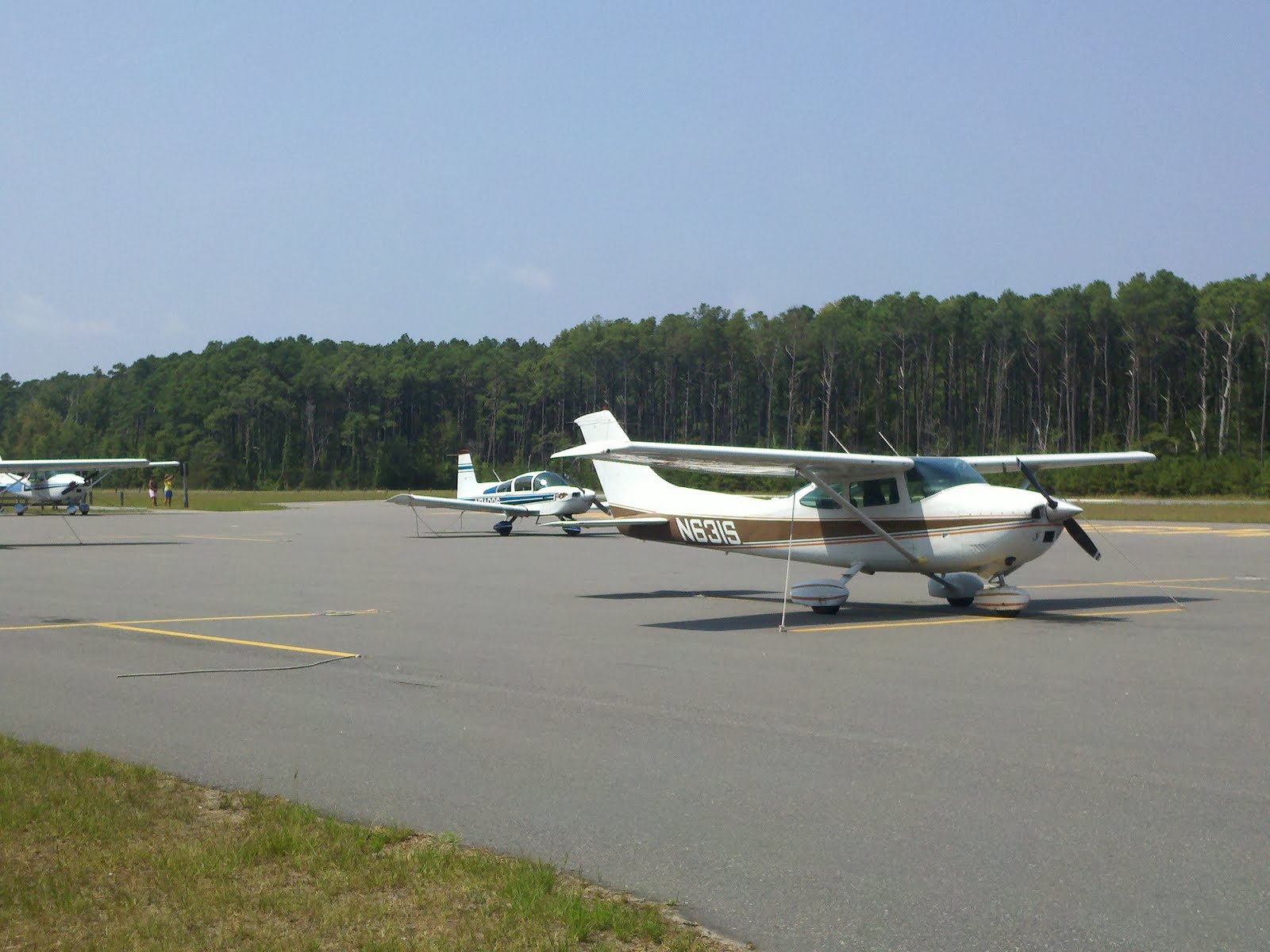
Last Sunday, Patricia and I took N631S down to the North Carolina Outer Banks and landed at First Flight Airport (KFFA). The little airfield is operated by the National Park Service as a part of the Wright Brothers National Memorial. It's a day VFR-only strip, but plenty of parking space is provided, free for 24 hours.

A few years ago, AOPA funded construction of a very nice pilot planning facility (with restrooms) immediately adjacent to the parking ramp. Access to the flight planning room, with its Internet-connected computer, is gained by entering "Squawk VFR + #-sign" into the electronic lock. There are picnic tables under shade trees for enjoyment of a pleasant lunch.

Our visit reminded me of a lesson learned years ago while visiting the Gettysburg battlefield. It's this: that you can study the events associated with an historic site all that you want, but a full understanding of what happened there will elude you until you walk the ground. The thing that had eluded me, despite having read many accounts of the Brothers' work at Kitty Hawk, was the great significance of the fourth flight of that December day in 1903.

We read all about the triumph and elation surrounding Orville's first flight, the culmination of those years of research and trial and error and cut and fit and test and adjust. We study that black-and-white image, captured at the perfect moment by Surfman J.T. Daniels – perhaps the most famous photograph in aviation history. Orville, in the Flyer, totally immersed in the immensely difficult task of controlling that balky steed. Wilbur, with the thing out of his hands, watching with time seeming almost suspended as history is made. And we, more than a century on, feel the thrill.

And oh, by the way, they made three more flights that day...before an errant gust of wind damaged the Flyer beyond quick repair. Three more flights from the launch rail in the sand, into the steady breeze. Those additional flights don't attract much interest...until you walk the ground.

The photograph at left is taken from the spot where Wilbur landed at the end of the fourth flight. Those small gray structures in the distance are replicas of the sheds that the Brothers built at Kitty Hawk...their "hangar" and the cabin they lived in. The launch rail was in the sand immediately adjacent to those structures. On it's fourth and final (ever!) flight, the Flyer took off from that distant point and flew all the way to where I stood to snap that image. The distance is more than four times that achieved on any of the first three flights. Farther than the first three flights added together. Far enough to be, arguably, the truly dominant success of that cold, windy Carolina morning.

852 feet. A sixth of a mile. 59 seconds. Nearly a minute of barely-controlled pitch-unstable 30 mph flight! This, then, was the confirmation. There could be no argument after the fourth flight, that this was any insignificant hop. The first flight made history, but the fourth showed that powered flight by heavier-than-air aircraft would thenceforth be part of the canon of human accomplishment. I walked back to the launch point, along the path that Orville and the other spectators hurried along 107 years and some months ago to congratulate Wilbur. I would never think about the First Flights in the same way again. In the end, that's what a pilgrimage is for, isn't it?

Thursday, May 5, 2011

"Fix Your Little Problem and Light This Candle"

Half a century ago, the fifth of May was a Friday and I was in 7th Grade in New Jersey. Shortly after the school day began our teachers marched us (the older kids, at least) into the small auditorium where a black-and-white television sat on a table on the stage. From our seats we squinted to discern history being made in the snowy image. Fifty years ago today, this is what we saw:


It's interesting to remember something that happened fifty years ago. An initial reaction is, "Damn! I'm older than dirt!" But then you can stop and reflect, and appreciate the perspective of the long view.

We watched as Cdr. Alan B. Shepard, Jr. became the first American to ride a rocket into space, inaugurating NASA's Manned Spaceflight Program. That first suborbital toe-in-the-water soon begat the Mercury orbital flights, then the Gemini developmental flights, then the Apollo missions that led - after just over eight years - to another black-and-white video image of Neil Armstrong stepping onto the surface of the Moon.

The most incredible adventure in the history of Western civilization started fifty years ago today. Guys in short-sleeved white shirts, with pocket protectors and, for God's sake, slide rules, designed and built incredible machines to take other guys, with ice water for blood and the famous Right Stuff, to another world and home again. There were heroes (Shepard was the first) and martyrs. There was the tragedy of the Apollo 1 fire, the triumph of Apollo XI and (before we awakened fully from the dream) the high drama of Apollo XIII. Oh, it was magnificent.

And then we lost interest. Just twelve years after Al Shepard told the engineers to "fix (their) little problem and light this candle," Gene Cernan climbed the ladder on Challenger, the Apollo XVII Lunar Module and became the last man to walk on the Moon. The last three Apollo missions were cancelled. The awesome Saturn V, the ultimate evolution of expendable rocket technology, flew once more to put Skylab into orbit, then never flew again.

It had never been about exploration. It had never been about choosing to do things because they are hard. It had always been about beating the Russians. Once the checkered flag had come down on the space race, the country turned away toward other concerns. NASA, left more or less without a job, lofted a few patchwork missions - three Skylab crews and ASTP - and waited around for the Space Transportation System (STS) - the Space Shuttle - to be ready.

NASA described the STS in glowing terms. We were going to make travel to Low Earth Orbit (LEO) routine. We would launch every two weeks. It would cost $100 to put a pound of stuff in orbit. We'd build observatories and space stations. Out of naiveté or desperation, they believed their own propaganda.

The Space Shuttle is a magnificent machine. But it was never going to be anything other than an incredibly complex, high-risk, experimental aerospace vehicle. The pre-Shuttle astronauts came almost exclusively from the ranks of test pilots, and they never had any illusions about their jobs. The Shuttle astronauts, despite the inclusion of scientists and engineers and politicians and a school teacher, have also always been test pilots. The way the game was rigged was exposed when Challenger exploded.

Now we are anticipating the launch in late June of the last Shuttle mission. Challenger and Columbia are gone, sacrificed to the normalization of deviance that bedevils so many technology-intensive programs. Discovery, Endeavour and Atlantis are headed for museums and American astronauts headed for the International Space Station will be hitching rides on Russian rockets. After a couple of months more than fifty years, the American Manned Spaceflight Program will end.

The Shuttle, conceived (or mis-conceived) in response to NASA's need for an ongoing mission, is a magnificent technological dead-end. A look at the history of technology and in particular the history of transportation technology, will reveal many comparable instances where a technical paradigm evolved to produce a machine so wholly admirable as to capture the heart, and yet destined for the scrapyard (or, if lucky, for static display).

Donald McKay's clipper ships were the ultimate embodiment of wind-driven maritime transport. For a time in the mid nineteenth century they dominated the sea lanes and yet in a flash, they were gone. Mundane but reliable coal-fired steamers drove the clippers from the seas.

The steamers had their own century, mid-nineteenth to mid-twentieth, and they too evolved to a peak exemplified by the liner SS United States. Nearly 60,000 tons, with a quarter-million shaft horsepower to drive her at nearly 40 knots, she had no peer on the trans-Atlantic run. But she did not sail for long before jet aircraft did to her what her ancestors did to the clippers. Now, she rusts quietly at a pier in Philadelphia.

The same jets that ended the career of the United States also wrote the last chapter for piston-engined commercial aircraft like the Lockheed Constellation. The "Connie", according to my friend Dennis Wolter "the most beautiful technological artifact ever designed by man," was the ultimate evolution of the propeller driven airliner and we aviation romantics can't forget the song of those four Wright R3350 turbo-compound engines. But beauty in commerce takes second seat to efficiency and so the Connie's and the DC-7's and the Stratocruisers went away.

The list goes on. The mighty steam locomotives, the graceful Concorde, and now, the Space Shuttle. Successful and at the same time doomed. Like the dinosaurs, unable to survive a changed environment.

It's been an exhilarating, exasperating ride these fifty years. I sat in that grammar school auditorium and watched Alan Shepard begin America's Manned Spaceflight Program. I watched its triumphs as the Apollo VIII crew circled the Moon at Christmas, 1968, and as Armstrong and Aldrin loped over the lunar surface. I held my breath as we waited for the Apollo XIII crew to come safely home and I suffered heartache in the aftermaths of the Challenger and Columbia tragedies. And I expect to watch the end of the journey as Atlantis plunges toward the threshold of the runway at Kennedy Space Center, flares at the last second and settles onto the ground for the last time. That, I expect, will be a bittersweet moment.

And then? Will manned space flight rise again, Phoenix-like, in this country - driven this time by the efforts of men like Sir Richard Branson and Elon Musk? Is a good dose of the American Entrepreneurial Spirit™ all that we need here? Pardon me if I am not reassured.

Let us toast the heroes and mourn the fallen. Let's retell the stories of great efforts and great achievements. And finally, always, let us hope.