Attention is invited to an addition to the list of blogs maintained in the sidebar: Aviation Trivia of the Day. It is curated by J.P. Santiago who describes himself as, among other worthy things, an "Aviation Über Geek."
The blog is a compendium of delightful arcana and obscurities from the world of aviation. I expect it to be a substantial time-sink for me as I spelunk through its archives. If you, too, are an "aviation geek", I believe that you'll enjoy repeated visits.
Tweet
Tuesday, January 18, 2011
Aviation Trivia of the Day


Thursday, January 13, 2011
(More) (Further) Thoughts on the ELT
Back in June of last year I discussed here an order promulgated by the FCC that would, with effect 60 days after publication in the Federal Register:
"...prohibit further certification, manufacture, importation, sale or use of 121.5 MHz ELTs."
This order caused a kerfuffle in the GA community, since the withdrawal of "approval" from 121.5 MHz ELT's would effectively place any aircraft using them in violation of 14CFR91 Subpart C Section 91.207.
Now, half a year later, the FCC has thought better of the whole thing. The Commission has issued a stay of the portion of its earlier order relating to 121.5 MHz ELT's.
The Commission carefully points out that:
"The FCC coordinated the Third Report and Order with NTIA (National Telecommunications and Information Administration) in November 2009. NTIA provided the draft version of the Third Report and Order to those agencies that participate in the IRAC (Interdepartment Radio Advisory Committee), including the FAA. The FAA raised no issues or objections to the portion pertaining to 121.5 MHz ELTs." (Emphasis added)
Of course, upon release of the Order, the FAA moved out smartly in pursuit of the horse that was now well out of the barn:
"On July 14, 2010, the (NTIA) forwarded to the Commission a request from the FAA that the Commission not implement this rule amendment. The FAA believes that the current supply of 406 MHz ELTs is not sufficient to replace all existing 121.5 MHz ELTs in the short term, so, given that most General Aviation aircraft are required to carry ELTs, a prohibition on 121.5 MHz ELTs would effectively ground most such aircraft. The FAA further asserts that 121.5 MHz ELTs can continue to provide a beneficial means of locating missing aircraft even without satellite monitoring of frequency 121.5 MHz, because the frequency is still monitored by the search and rescue community, including the Civil Air Patrol. It also is concerned about the cost of equipping aircraft with 406 MHz ELTs."
After a suitable period of bureaucratic soul-searching, the Commission has now stated that:
"Under these circumstances, we believe it would be in the public interest to further consider what actions the Commission should take in light of the termination of satellite monitoring of frequency 121.5 MHz, with the benefit of an augmented record. Toward that end, we will stay that portion of the Third Report and Order prohibiting the certification, manufacture, importation, sale or use of 121.5 MHz ELTs. No action will be taken regarding 121.5 MHz ELTs until further notice, following an additional opportunity for interested parties to comment."
Y'all can relax now. Let us hope with fervor that the now-ever-vigilant FAA can (via the IRAC and the NTIA) keep the FCC from doing anything rash with regard to ELT's.
After the Storm
Yesterday's storm deposited 16 inches of snow on KBDR and this morning the airport is digging out. Most of the movement areas have been cleared (more or less) and final cleanup is in progress.

Meanwhile, the forecast for tomorrow afternoon and evening is favorable for a flight down to the DC area. I hope to take advantage of that.
Monday, January 10, 2011
A Visit to Potomac Approach
One Friday evening back in mid-December, N631S and I were in the home stretch of our weekly trip from Connecticut down to the DC area. I checked in with the second Potomac Approach sector and the controller gave me an altimeter setting and asked if I had time for a question.
I said, "Sure!" and he asked whether I'd ever visited the TRACON (that's short for Terminal RAdar CONtrol, a/k/a "Potomac Approach"). I told him I had not.
He said, "My name's Eric; one of the other controllers here, Sarah, has introduced some of us to your blog and we'd like to invite you out here for a tour."
Well, that is not the sort of thing about which I need to be asked more than once. I told Eric that I'd love to, and that I'd co-ordinate through Sarah. (Sarah, incidentally, maintains a neat blog called Adventures of an Adventurer, which is linked in the sidebar over on the right.)
Sarah and I exchanged e-mails to settle on time and date and yesterday morning a good friend and I drove from Alexandria out to the Potomac Consolidated TRACON (PCT) facility in Warrenton, VA. We cleared security and Sarah came out to collect us. On the way in she explained that PCT is comprised of four sectors similar in size and scope and she'd be showing us the Mount Vernon sector where she works. We passed through a lobby, then through a doorway and came out on the bridge of the Starship Enterprise!
 |
| Potomac Consolidated TRACON (PCT) |
First, I asked to see where the voice of Mt. Vernon Flight Data - from whom I pick up my outbound clearance on Monday mornings - originates. She showed us that station and we discussed some aspects of clearances and departures in the DCA airspace. I learned that any time I can depart VFR it saves the controllers working DCA arrivals and departures a fair amount of trouble. I also know, now, why it's better on occasions when the weather demands an IFR departure to depart Runway 6 at KVKX rather than Runway 24. (It has to do with the initial heading providing a diverging flight path relative to DCA traffic, while Runway 24 would be converging...which is less good.)
We then moved to one of the radar monitors around the circumference of the room and Sarah brought up a live display of the Washington Class B airspace. I was very interested in seeing how the RNAV Rwy 6 approach at KVKX cuts directly across the localizer for the ILS Rwy 1 at KDCA. Therefore, if I need to fly the instrument approach, the controller working KDCA arrivals has to orchestrate a gap in the arrival stream timed to let me slip in - no mean feat!
We talked about the fact that they always want me at 6,000 feet crossing KBWI on Friday evenings to avoid the arrival and departure flows. I asked, if I really needed 4,000 to avoid icing conditions could that be worked out? Sarah assured me that they were sensitive to pilots' needs to avoid adverse weather and would always work out a safe, acceptable flight path. All I have to do is ask for what I need and tell them why I need it.
Speaking of weather, my one disappointment is that for this visit there wasn't any! It was a perfectly clear morning, so we couldn't see the radar's weather display capability. Sarah agreed with my impression that the Approach Control radar has pretty good weather depiction capability. To minimize clutter, she usually works with the Level 1 and Level 2 returns suppressed (that's the green stuff on the NEXRAD display), but will watch the Level 3 and up returns and will work with us to stay clear of the mean stuff.
I asked Sarah if there was one thing we pilots could do to make the job she and her colleagues do a bit easier. She said that when the frequency is busy, we should be judicious in our readbacks and make more use of "Wilco". Yes, we need to read back altitude restrictions and approach clearances and the like. But for many transmissions, "Wilco" is a perfectly fine acknowledgement.

Friday, December 31, 2010
100 is a Nice Round Number
For no reason other than this: a total of 100 posts in 2010 is more satisfying than a mere 99.

Happy New Year (with a look back)
New Year's Eve is a good time to look back at the twelve months just passed, as I did just a year ago in this posting. Now I have a second full year of experience with my nearly-every-week commute between Virginia and Connecticut so comparisons are possible.
N631S finished the year with 4,031.5 hours on the tach, having flown 177.9 hours in 2010. That's about 14% less than the 2009 total of 207.2 hours. Yet I made the round trip 37 and 1/2 times this year, twice more than last year. Maybe 31 Sierra is getting faster?
Actually, I suspect that the difference is attributable, at least in part, to better weather. (I discussed this earlier, in part, in this posting.) I logged 12.9 hours in actual IMC (instrument meteorological conditions) this year, less than half of 2009's 26.7 hours. Oddly, this year's total of 14 approaches flown in actual conditions is only down from last year by one.
Here's a possible partial explanation: This year many more of these approaches were flown into Bridgeport (KBDR), and those approaches can be flown rather efficiently. Not one was into Potomac Airfield (KVKX), in contrast with 2009 when I flew the RNAV Rwy 6 approach there eight times. That approach requires a considerable excursion to the southwest and will add a fair bit of time to the flight.
The same rationale may explain, in part, the fact that time logged at night for 2010 at 9.2 hours was just half the 18.4 night hours logged in 2009.
It's obvious that all of this couldn't have occurred unless N631S was an admirably reliable machine. In 2010 I experienced only two equipment failures and neither of these caused me to miss a flight I'd otherwise have taken. In July a brake master cylinder attachment bracket failed while taxiing after landing (discussed in this posting), and in August a wiring problem caused the autopilot to fail in IMC (discussed in this posting and in this one).
For me, 2010 has been a rewarding and enjoyable year of aviating. I hope it's been so for all of you as well. As always I am grateful for your visits (and especially comments!), and I hope you've found this blog interesting and perhaps on occasion even useful. So, Happy New Year! I hope that we all will enjoy a healthful, prosperous and safe 2011.
Tweet
...and It Was Good
As anticipated in the previous posting, yesterday's flight from KBDR in Connecticut down to KVKX in the DC area was pleasant and uneventful. For most of the trip N631S and I cruised under altostratus layers a couple of thousand fee above us, mostly in temperatures above freezing. The photo below is typical.

We did come upon a cold (27F) cloud layer at 8,000 feet MSL just north of Lancaster (KLNS). I requested a descent to 6,000 in expectation of warmer air. The descent, quickly approved by Harrisburg approach, also put us below the clouds, and that was the extent of IMC for the day.
Here's the track for the flight, courtesy of FlightAware.com:

I'd be remiss if I neglected to report an embarrassing moment that occurred prior to departure. I am theological about leaning the fuel mixture going to N631S's big O-470U engine aggressively right after start. I go to full-rich for the run-up and leave it thus for takeoff. Leaning for ground op's keeps the spark plugs from fouling and is generally good for the engine. Here is an excerpt from the gospel according to Capt. John Deakin (Pelican's Perch #77):
Running [very] lean (lean of peak power) on the ground also absolutely prevents you from taking off with the mixture leaned. This is not true if you take half-measures: Either do it this way, or leave it full rich. I don't care how faithfully you use checklists, you will someday attempt a takeoff with the mixture leaned. If you have properly leaned for taxi, the engine will simply wheeze and lose power, making it very obvious you're not going anywhere...Well, this was the time I forgot to go to full rich for the run-up. I am now able to offer personal testimony that an aggressively leaned Continental O-470U will not keep running if one mag is shut off. I re-started immediately...maybe nobody noticed?
Lean it aggressively on the ground, or not at all!
Tweet
Thursday, December 30, 2010
This Should Be Good
After an AmTrak weekend last week, it's looking good for the flight from KBDR to KVKX this afternoon. First, and most importantly, N631S is free from the snows of last weekend. Actually, the high winds associated with the weather event did most of the work leaving the need for only minor shoveling on Tuesday.

 The weather map is showing the eastern portion of the country dominated by high pressure which should lead to fair weather. (The map at left is the forecast for 18Z derived from the NAM model.)


The Terminal Area Forecasts (TAF's) for the afternoon and evening look good. Here are the 15Z forecasts issued for my departure and arrival locations.
KBDR 301435Z 3015/3112 VRB03KT P6SM SCT250
     TEMPO 3015/3017 5SM HZ
     FM301700 27005KT P6SM BKN200
     FM302200 VRB03KT P6SM SCT050 BKN100
     TEMPO 3109/3112 3SM BR

KDCA 301454Z 3015/3112 20003KT P6SM SCT150 BKN200
     FM301700 14005KT P6SM BKN100 OVC120
     FM302000 17006KT P6SM SCT060 BKN090
     FM310000 19005KT P6SM SCT090 SCT120
     FM310600 19003KT P6SM FEW100 BKN200
Bridgeport is expecting light winds from the west and some high cirrus, while DCA is calling for scattered clouds at 6,000 feet under a 9,000 foot overcast and light winds from the south.So it looks like I can anticipate an uneventful trip for what will probably be N631S's last flight of 2010.
Saturday, December 18, 2010
Words in Flight
Google has gifted us with a fascinating tool for exploring the evolution of language as it surrounds and relates to any facet of human activity. The Google Books Ngram Viewer lets us query the vast corpus of books Google has digitized to learn how frequently a word or phrase of interest has appeared in print over the decades. How can we resist looking through this lens at the evolution of the language of aviation?
 We begin, of course, with aviation. The word is little seen until about 1905. Then it increases gradually in frequency of appearance until it experiences a significant "bump" in usage during the First World War. There is a plateau of increased usage in the 1930's, then a vast increase during the years of the Second World War. After that, usage declines to a fairly steady level from 1950 to the preesent of about 5/10,000'ths of 1 percent (or about 1 of every 200,000 words published in the English language. (At it's peak during WW II, for every 50,000 words printed in English aviation appeared once.)
 But what shall we call these wondrous machines? Until about 1920, the clear leader was aeroplane (the blue curve). In the 1930's, airplane (red) and aircraft (green) came to the fore, about equally for a decade or so. Then aircraft became established as the most common term, perhaps because it encompassed such variants as rotorcraft and lighter-than-air vehicles. As is common, both terms experience the WW II "bump".
 From about 1908 until the early 1920's, the term biplane (red) was more common than monoplane (blue). Then the tables turned and from the mid-1920's until 1950 or so, monoplane was predominant. After 1950, biplane once again overtakes monoplane in frequency of mention - not because of all the biplanes flying about but because the monoplane configuration had become the default in aircraft design. To complete the picture, the green curve shows the frequency for the term triplane, with a bump during WW I in honor of the Fokker and Sopwith exemplars.
 In another battle of competing types, the mid-1930's can be seen as the heyday of the autogiro/autogyro (red/green respectively). These unusual rotorcraft briefly outdid the helicopter (blue) in literary frequency but soon lapsed into comparative obscurity.
 We can look also at the terms for the lighter-than-air (LTA) types. Airship (blue) has always been the popular reference, but through the 1920's and 1930's dirigible (red) experienced significant popularity, thereafter declining. Blimp (green) emerged in the late 1930's and by the late 1970's had caught up to dirigible, but airship continues as the dominant term.
 From before 1910 until the mid-1920's, flying machines operated mostly from an aerodrome (blue). But then airport (green) surged into dominance and has grown in popularity ever since. Airfield (red) had a period of significant popularity through the '40's and '50's (perhaps because of its being a preferred term in the military) but its usage has declined over the past half century.
 What are we to call those who fly? Until about 1907, those magnificent men (always, then) in their flying machines were aeronauts (blue). Thereafter, aviator rises quickly to prominence and remains the dominant term. It's interesting that the usage of aviator is greater in the WW I years than in WW II. This may be due to the greater use of "pilot" in the latter period. (I've omitted "pilot" from this discussion because of the many alternate senses of the word (e.g., the maritime pilot, the "pilot project") that tend to confuse the relationships.)
 Among the other terms applied to fliers in the early years was one that sputtered and failed to rise in popularity - airgonaut. This term was coined in 1784 in a letter by the English writer Horace Walpole. The ngram shows very occasional usage from 1840 to the present, but no sustained prevalence. A orphaned word!
 The evolution of technology can be seen in the evolution of terminology. Here, one sees the term tailwheel being matched in frequency from the mid-1940's and then eclipsed from the early 1950's by the term nosewheel. This period corresponds closely to the shift from conventional landing gear to tricycle landing gear as the dominant design paradigm in aviation.
 Another tale of technical evolution is seen in the rise in use of the terms blind flying or flying blind (blue/red respectively) from the mid-1920's (when aviators first began to seriously challenge the clouds) through WW II. The technological response, the autopilot, emerges in the war years and rises to considerable prominence in the '50's and '60's. In the same period, the earlier phrases fall into dis-use as the problems they represent fade also to insignificance.
 As a last example, look at the terms for types of instrument approaches. The ILS Approach (blue) appears about 1945 and garners lots of attention from then on. In the mid-1950's the terms VOR Approach (red) and NDB Approach (green) emerge and over the next decades show substantial usage. But look at the trends after the year 2000! All of the "legacy" terms for instrument approaches decline in use. The rising curve (yellow) represents GPS Approach. And time marches on...
As usual, all of the figures below can be enlarged with a click.


Again, the link to the engine that generates these comparison curves is: Google Ngram Viewer. Have some fun with it, but use caution, as it tends to be addicting.
Tuesday, December 14, 2010
Winter Ops
Winter operations present a challenging environment that demands thorough planning, continuous assessment of conditions and careful management of options. N631S's flight last Friday from KBDR to KVKX brought all of that home for me.
I'd been watching the weather carefully for a day or so. It had been cold and dry in the northeast but an approaching system was promising to make things interesting. The low would pass to the north but we'd be getting a sequence of warm front, precipitation and cold front. The warm front was due at about flight time and might have precipitation associated with it.
Here are excerpts from 12Z Friday morning Terminal Area Forecasts (TAF's) with the expected weather for the time period that I'd be interested in.
TAF KBDR 101122Z 1012/1112 ...
FM101800 17006KT P6SM BKN080 OVC100
FM102200 17006KT P6SM BKN040 OVC070...

TAF KJFK 101122Z 1012/1118 ...
FM101700 17008KT P6SM BKN080 OVC100
FM102100 17008KT P6SM BKN040 OVC070...

TAF KABE 101131Z 1012/1112 ...
FM101700 18008KT P6SM SCT030 BKN060...

TAF KRDG 101131Z 1012/1112 ...
FM101700 18008KT P6SM SCT030 BKN060
FM102300 00000KT P6SM BKN100...

TAF KMDT 101134Z 1012/1112 ...
FM101700 16008KT P6SM BKN060
FM102000 18007KT P6SM BKN050...

TAF KBWI 101132Z 1012/1118 ...
FM101800 19009KT P6SM SCT035 SCT060 BKN120
FM102300 16004KT P6SM SCT150=

TAF KDCA 101132Z 1012/1112 ...
FM101700 18011KT P6SM SCT050 SCT080 BKN150
FM102300 17005KT P6SM SCT150=
(Note: Prior period TAF's (and a cornucopia of other climatological data) can be gotten from Ogimet, a wonderful resource developed by Guillermo Ballester Valor, meteorologist from the Spanish Meteorological Institute (INM).)All that is not so bad. I was particularly interested in Allentown (KABE), Reading (KRDG) and Harrisburg (KMDT) because the weather would be approaching from the west and anything unpleasant would get there first. Those stations were showing some lower clouds (SCT030, scattered at 3,000) than the New York area. So on general principals I filed for an eastern route over New Jersey: KBDR DPK V16 ENO V312 OTT direct. Not that I expected to get that.
Things got a little more interesting as the day progressed. When the 18Z TAF's came up (a bit before 1:00 PM local time), the Pennsylvania stations had gotten a bit more pessimistic:
TAF KABE 101732Z 1018/1118 17007KT P6SM SCT030 BKN060
FM102300 VRB03KT P6SM BKN120...

KRDG 102222Z 1022/1118 17008KT P6SM SCT030 BKN060
TEMPO 1022/1024 P6SM -SN...

TAF KMDT 101740Z 1018/1118 18010G15KT 1 1/2SM -SN OVC017
TEMPO 1018/1019 3SM -SN OVC025
FM101930 19008KT P6SM BKN060 FM102000 18007KT P6SM BKN050...
The Harrisburg (KMDT) TAF got my attention. At 18Z they were having continuous light snow with a mile and a half visibility under a 1,700 foot overcast. That's not good at all. The snow was gone from the forecast by 1930Z...but did I want to bet that way? I took another look at Atlantic City:
TAF KACY 101732Z 1018/1118 15008KT P6SM SCT030 BKN060
FM102300 VRB03KT P6SM BKN080=...
That looked a whole lot better than Pennsylvania, with scattered to broken layers improving to a high ceiling by 23Z. The forecasts for KBWI and KDCA were holding up nicely and the departure was looking acceptable:
TAF KBDR 101737Z 1018/1118 08006KT P6SM SCT040 BKN110 BKN250
FM102100 15006KT P6SM VCSH BKN040 OVC070...

TAF KJFK 101737Z 1018/1124 13007KT P6SM SCT040 BKN110 OVC250
FM102100 16008KT P6SM BKN040 OVC070...
The one thing in the KBDR TAF that would need watching was the "VCSH" (showers in the vicinity) after 21Z. And, of course, I'd had an e-mail from FltPlan.com advising me to expect the routing over Pennsylvania as my clearance. I resolved to (a) be on my way prior to 21Z, and (b) insist on the New Jersey routing.I had called the FBO earlier and asked them to plug in N631S's Tanis pre-heat system by noon. When I got to KBDR about 20Z, the engine was all toasty and ready to go. I quickly accomplished the pre-flight inspection and picked up the hand-held radio:
Me: "Bridgeport Clearance Delivery, November 631 Sierra."I started the engine, to allow it to warm up while I waited for ATC to figure out what to do about me. I was a bit surprised (in a pleasant way) when Bridgeport tower came back to me with an excellent clearance: Vectors to DPK V16 ENO V268 SWANN Direct. ENO is the Smyrna VOR near Dover AFB; V268 departs ENO to the west and SWANN is 35 miles along that airway. This was good!
KBDR: "631 Sierra, go ahead."
Me: "631 Sierra is filed IFR to VKX. I'm advised that you're going to read me a clearance via Sparta to Solberg to East Texas, etc. I am going to say "Unable" to that clearance due to icing conditions over Pennsylvania. Request you go back to Appraoch and get something for me that starts out 'vectors to Deer Park, V16...'"
KBDR: "631 Sierra, stand by."
I entered the route into the Garmin GNS-530 and called for taxi clearance. As I taxied toward Runway 6 it began to snow. The forecast "VCSH" was a bit early.
This was the METAR in effect when I got to the airport:
KBDR 101952Z 09005KT 10SM OVC085 M02/M10 A3037 RMK AO2 SLP284
Snow? What snow? But the NEXRAD display on my GPS-396 showed there were bands of light snow, oriented N-S, crossing the area. And one band had arrived at KBDR. I sat at the hold-short line waiting for a Baron that was on the ILS 6 approach, and thinking about the snow. I heard the voice of my old instructor, Bob Parks, almost as though it was coming from the unoccupied seat next to me:"Snow's not a problem as long as it's dry snow. It doesn't stick to the airplane. But it makes it very hard to see."The Baron emerged from the cloud on short final. After it touched down, tower asked the pilot for flight conditions and braking action. He reported, "Flight visibility is three miles, ceiling indefinite. Braking action is good."
As the Baron turned off I reviewed my situation.
- First, the snow was powdery and not adhering to the aircraft.
- The outside temperature (OAT) was 29F.
- The Baron had reported no problems.
- As soon as I got a turn to the west I'd be out of it in minutes.
- Ol' Bob had said you could fly in this if you didn't mind not being able to see.
- And if N631S picked up any ice I could loop right around to the ILS 6 in short order.
As N631S and I lifted off at 2028Z the following METAR was posted for KBDR:
KBDR 102028Z 08003KT 4SM -SN OVC026 M02/M08 A3037 RMK AO2 SNB24
The AWOS system thought the ceiling was at 2,600 feet but we were in the schmoo at about 900. It had been snowing for four minutes. I'd been given a heading of 090 by the tower and told to contact Approach. The New York controller cleared me up to 3,000 feet and turned me to the south. Climbing out in IMC, I added two things to my normal scan: the leading edge of the wing strut and the OAT. If any ice began to adhere to the airframe it would show up first on the strut. And, as long as the temperature kept dropping with altitude, I would probably be in good shape. If I saw a rise in temperature (indicating an inversion), I'd be concerned that the snow might change to mixed precipitation and result in ice accumulation.


The screenshot at left shows the snow band I'd just left behind, moving off to the east. Other precipitation appears downrange beyond JFK, but at 6,000 feet (and later back down to 4,000) it was never a factor for the flight. The forecasts of improving weather from southern New Jersey into the DC area verified nicely. The remainder of the trip, as evening fell, was quite pleasant.
Below, the flight track courtesy of FlightAware.com. The weather depiction in that image corresponds to the time that N631S and I were about 50 NM past JFK.

Tuesday, December 7, 2010
A Winter's Day
Yesterday was just one of those days when the flight was interesting.

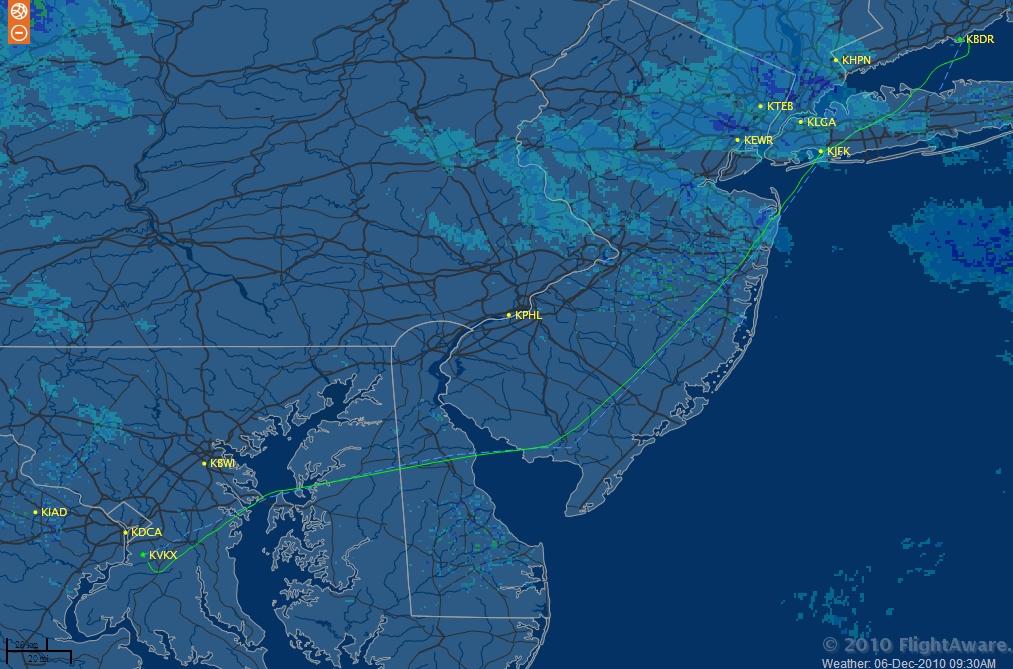
It was the usual Monday morning trip from Potomac Airfield (KVKX) to Bridgeport (KBDR). I got to the airport soon after 0700, opened N631S's hangar and got the pre-heat system plugged in. The temperature was 30F; I decided that 40 minutes of pre-heat was in order.
In due course I pulled the airplane out, put the car into the hangar, closed the hangar doors and started the big Continental engine. It was perfectly happy to turn over and run and I taxied to the fuel island to fill the tanks (which I'd skipped on Friday evening when I was anxious to be home). Park and shut down; set up ladder; attach grounding cable; insert fuel card in card reader; select fuel pump; start pump; pull out about 25 feet of hose; climb ladder; remove fuel cap; squeeze trigger. Nothing. Nada. No stream of fuel from the nozzle. The pump would not run continuously.
OK. Use colorful language; push airplane back so the other pump can reach it. Repeat much of the procedure above. This time 100LL emerges from the nozzle in a gratifying stream.
I went into the FBO office and left a note advising that Pump #2 was hors d'combat and called Mt. Vernon TRACON to collect my clearance. The weather at VKX was clear but the forecast was calling for scattered to broken clouds over Maryland, Delaware and southern New Jersey anywhere from 4,000 to 5,500 MSL. In the hope of avoiding those layers I'd filed for the Victor 1 (V1) airway at 7,000 feet.
It's been my experience that layers advertised as "scattered" or "broken" are usually not very thick, so about 2,000 feet above the bases will get you to "on top". With a layer described as "overcast" all bets are off.
What I got in my clearance was V16 with an initial altitude of 7,000 feet. This is where a little specific knowledge of ATC's quirks is very handy. If I get the V1 route I can stay at 7,000 as far as McGuire (AFB) Approach airspace, but if I am on the more westerly V16 I'll be forced down to 5,000 feet by Dover (AFB) Approach to avoid conflicting with KPHL arrivals.
There's no point in talking to Mt. Vernon about this. I accept the clearance with the plan of negotiating with Dover Approach to trade V16 for V1. Back outside, start up N631S, and take off. Wheels up time was 0824.
The climb to 7,000 feet put me nicely on top and in the sunshine. The outside air temperature at that altitude was a snappy 5F. All good. But I needed to think about the weather situation at the northern end of the route. KJFK was reporting light snow (see the blue radar returns on the FlightAware.com screen-shot above). The airports surrounding New York were reporting broken to overcast cloud decks from 3,500 to 5,500 feet. And that was a potential problem because...
On the route I was flying it is customary upon reaching the Coyle VOR (CYN) to have McGuire Approach say, "November 31 Sierra, descend and maintain 5,000 feet." They seem to have an agreement with New York Approach to feed them northbound traffic at that altitude. And, if McGuire brought me down to 5,000 I would probably be in the thick of the cloud cover in the New York Class B airspace with a pretty high probability of ice accumulation.
So when Atlantic City Approach told me to contact McGuire, I checked in with, "McGuire Approach, Skylane 631 Sierra, level 7,000 with a request."
"November 631 Sierra, McGuire altimeter 29.62, what is you're request."
"You need to descend me to 5,000 somewhere around Coyle, but that altitude will put me into the cloud layer over New York. Could you ask them if I could cross the Class Bravo at 7,000 for icing avoidance."
"November 631 Sierra, it's on request." I'd never seen that work before; but I never asked that way before.
And, a few minutes later I got, "November 631 Sierra, you can plan on 7,000." Yes! Have I mentioned that I really like ATC?
As N631S and I approached the southern border of New York Approach airspace the heaviest cloud coverage was just south of the outer bay. It looked a little better crossing Long Island, and Bridgeport wasn't bad at all. Here are some of the relevant METAR's, arranged from south to north:
KMJX 061435Z AUTO 29016G25KT 10SM FEW050 SCT060 OVC075 01/M09 A2961 RMK AO1
KBLM 061435Z AUTO 28015G24KT 10SM BKN048 OVC055 00/M11 A2960 RMK AO1
KJFK 061451Z 28023G29KT 8SM -SN SCT029 BKN038 BKN048 BKN250 01/M07 A2955 RMK AO2 PK WND 27029/1449 SNE1356B33 SLP006 P0000 60000 T00061067 58011 $
KBDR 061452Z 29017G24KT 10SM FEW035 SCT110 M01/M09 A2948 RMK AO2 SLP982 T10061089 58015
MJX is Miller Airpark in Toms River, NJ, well south of New York. They were reporting few clouds at 5,000, scattered at 6,000 and overcast at 7,500 - really fairly nice. BLM (Belmar/Monmouth County), within New York Approach airspace, was a different story with broken to overcast layers from 4,800 to 5,500. As I passed over KBLM, N631S was in and out of the tops at 7,000 - never long enough for any ice to accrete. In fact, at 5F it may well be too cold for ice to adhere to the airframe.JFK had light snow and scattered to broken layers at 2,900, 3,800, 4,800 and way up at 25,000 feet. At 7,000 feet I was in the clear. As N631S and I crossed Kennedy and made the north-eastward turn toward Bridgeport they asked me to descend to 5,000. Ahead I could see that the clouds were opening up so I didn't feel concerned. I had some light turbulence in the descent but no ice.
Before I got down to 5,000 feet Approach issued a descent to 3,000 and that got me under all of the cloud layers. The flight across a very churned up Long Island Sound was bumpy but brief and the wind at KBDR was 17 knots gusting to 24, right down the middle of Runway 29. N631S and I were on the ground at 1033.
Sunday, November 28, 2010
Oil Change
Yesterday was the day to change N631S's engine oil. It's a long weekend and the time was available. The oil had 46 hours on it - it was about "used up." And finally, cold weather is upon us. The oil that had been in service for the last three months is Aeroshell 100W, which has an SAE 50 viscosity rating. For the winter months I like to switch to less viscous Aeroshell 80W, an SAE 40 oil.
 My first step on arriving at N631S's hangar is to remove the top cowling and hook up the Tanis engine pre-heater. The oil has to be warm to drain properly and there are two ways to make that happen - go fly the airplane, or apply pre-heat to the engine. It's easiest for me to use the electric pre-heat system for an hour, since pattern operations are not permitted at KVKX ("National Security" and all that).
  To drain the oil on a 182 you have to remove the lower cowl. To do that, you first have to separate the halves of the landing light electrical connector. It lives just inside the access door for the oil dip-stick and is normally secured with small nylon Ty-raps (to prevent the connector from separating due to vibration). Cut the Ty-raps and split the connector.
  Next, disconnect the cowl flaps from their operating cables. A 3/8" wrench and 3/8" socket on a small ratchet work out nicely. The nuts are elastic stop nuts with nylon inserts, with a flat washer under each. For each cowl flap, remove the nut and washer, pull the bolt out of the clevis, let the cowl flap drop and put the bolt back in the clevis. Secure the bolts with the washers and nuts so that the hardware bits can't go adrift and get lost.
  Now you'll be wanting to get the oil started draining. It's really good if one of these "quick drain" fittings (at left) is installed. You can push and turn the knurled collar and the fitting will lock in the open position to allow the oil to drain. On N631S, a piece of 1" Tygon tubing about two feet long fits nicely over the quick drain and allows the oil to flow into the pail in a neat and orderly way. Once the oil is draining you can turn your attention to the filter.
  The oil filter is located so as to maximize awkwardness. Access to the filter is obstructed by various components and parts of the engine mount. To further complicate matters, the filter is full of oil that will want to get out and get all over everything as soon as you try to remove it. Everyone has their own set of home-brewed procedures to minimize the mess - here's what I do. First, I reach in with a pair of cutting pliers and cut the safety wire. Then, I use a 1/2" drive ratchet with a 1" socket to loosen the filter until I can just turn it by hand. I then slide a one gallon zip lock plastic bag up over the body of the filter.
  Then, the special tool shown at left (an old oil bottle with one side cut out of it) gets slid under the bag and filter to (I hope) collect oil that may escape.
  As the oil continues to drain you can thread the new filter into place, having coated its rubber gasket with Dow-Corning DC-4 silicone grease (or, if you are fresh out of DC-4, a film of clean engine oil). Use your calibrated torque wrench (as shown above) to tighten the filter to a torque of 16-18 ft. lbs.
  Cut a longish piece of safety wire (a couple of feet at least) and thread it through the drilled "ear" on the filter adapter. Pull the wire through until you have two strands of equal length. Mark a spot on the double strand corresponding to the distance to one of the holes on the filter - pick one that, if restrained, will prevent the filter from "unscrewing." Add about 20% more length to account for the fact that when you twist the wire it will shorten up, and clamp the safety wire pliers onto the two strands at that point. Use the pliers' twisting mechanism to twist the paired wire, aiming for about 6 to 8 turns per inch.
  When the length of the twisted wire is about right to reach the tie-off point on the filter, thread an end through that hole and then use the pliers to twist the free ends together thus securing the filter. Cut off the excess wire, leaving about a 1/2" "pig-tail" and use pliers to turn the pig-tail under, so that the next person to stick their hand near there doesn't get "bitten."
  Now the filter is securely installed, and the oil is probably about done draining from the crankcase. Close the quick-drain fitting and begin pouring quarts of fresh oil into the engine. The crankcase capacity of the O-470 engine in the 182 is 12 quarts but I've learned that the engine will blow off two quarts very quickly and will settle down at the 10 quart level. So I put in 10 quarts to begin with.
Of course, changing the oil is one of the items of Preventive Maintenance authorized for accomplishment by the holder of a Private Pilot's certificate under 14 CFR 43 Appendix A Section (c).
To change the oil in a Cessna 182 the following items are essential:
- 10 quarts of oil;
- An oil filter;
- An oil analysis kit;
- Safety wire (the 0.032" flavor);
- Safety wire pliers;
- A couple of small nylon cable ties ("Ty-raps");
- A torque wrench with a 1" socket;
- A 5 gallon pail;
- The usual array of basic tools;
- A helper (to wrangle the lower cowl).


The third item is up there in the darkness beyond the cowl flap. The air inlet duct from the air filter is secured to the carburetor inlet air box on each side by a 1/4-turn fastener. If you are fortunate they will be "wing-nut" sorts of an animals and you can reach way up there and separate them manually. If you are not so fortunate you may have to engage them with an appropriate screwdriver, which is more difficult and requires more colorful language.
Once all three connections are disconnected you can unfasten the 1/4-turn Cleco fasteners that secure the lower cowl in place (taking care not to forget the two that are way down at the bottom just to the left and right of the nose gear strut) and carefully lower the cowl clear of the exhaust pipe and carry it away. (This is where your helper earns his keep.)


I unscrew the filter as quickly as possible, keeping a roll of paper towel handy.
Once the filter has been detached and extracted and the area has been cleaned up, untwist and remove any left-over safety wire that may still be hanging from the filter adapter. Then, take a good look at the filter adapter. There is an Airworthiness Directive, AD 96-12-22, that applies to Cessna 182 aircraft. It requires inspection of the oil filter adapter at every oil change and in particular focuses on the integrity of the torque putty applied to the joint at the base of the adapter. (If the putty is broken it indicates that the filter adapter is not secure.) This is one of the few inspections that can be accomplished by a Private Pilot, and it has to be logged in the airplane's maintenance records.
The oil has been draining for a few minutes by this time so it's a good opportunity to capture a small sample of the used oil to send off for spectrometric analysis. I use the kits provided by Aviation Laboratories of Houston, Texas. They provide very nice on-line reports of their analytical results.


With the oil in the engine, pull the airplane out of the hangar and start it up. Watch the oil pressure closely, and if the gage doesn't respond in a few seconds, shut down and find out why not. Don't run the engine too long, as it's un-cowled and therefore isn't being cooled properly. After a couple of minutes shut down and inspect the engine for any evidence of leaks.
If everything looks tight and dry you can re-cowl the airplane (usually the hardest part of the entire job). You'll need your helper again to get the lower cowl in place. Remember to re-secure the two fasteners for the air-box duct, the two cowl flap clevises and the landing light connector - which will need a couple of new Ty-raps.
And that's it! All that's left is to make the appropriate entry in the engine's maintenance log, send off the oil sample to the lab, and cut open the filter to inspect the media for stray metal (which process will be the subject of a future post.)
Thursday, November 25, 2010
An Existential Question
 |
| Photo: Paul King Mansfield |
The question got me to thinking about, first, why do I fly? And second, why do all of us fly? At first, specious answers suggested themselves:
- "It's fun!"
- "Flying is so convenient."
- "Because I can!"
But none of the easy answers really captured the motivation that leads me to engage in a costly activity with (let's face it) heightened risk, on a regular basis. In the end, this is the response I gave to Toria's question:
Why do I fly?I fly because in flying there is no pretense, no prevarication, no dishonesty. The airplane doesn't know your family name or your pedigree. It can't read your resumé or check your references. It cares not about the color of your skin, or your gender, or where, if anywhere, you bow before your god.
The airplane only cares that your hand and your mind and your heart can become one with it when, together, you have to deal with the fierce crosswind, or the frontal weather, or the icy threats of winter.
The airplane looks back at you and says, "Do or do not. There is no 'try'." But when you give the airplane what it needs from you, it returns a satisfaction that is rare in our world. And that is a priceless gift.
But that's just me. Other pilots certainly respond most powerfully to other satisfactions. Some relish the freedom of flying a J-3 Cub from a rural grass strip and cruising, low and slow, over the countryside. Others may crave the adrenalin rush that comes with taking a fully aerobatic Yak-52 to the edge of its performance envelope for an air show crowd. The warbird owner may sacrifice many things for the feeling that when he keeps his 65 year old T-6 flying he is in touch with, and part of, the amazing tradition of aviation in America.
I'm pretty certain that there are almost as many reasons to fly as there are aviators. And that's a wonderful thing because it preserves the variety and vitality of aviation.
So, my flying friends, think it over for a few minutes. Of all of the reasons to fly, all of the rewards to be had, which one speaks most clearly to you? And when you have it figured out, go on over to Toria's blog and leave your answer to her question.
Wednesday, November 24, 2010
'Blow, Blow, Thou Winter Wind'
| -- As You Like It (II, vii) |
I could cheat a bit by lining up toward the left side of the 150-foot-wide runway and angling my initial takeoff roll into the wind to cut down the crosswind angle. I'll see what the actual conditions are when the time comes.

But the skies are clear and I'm going home for the holiday weekend. Life is good! To all who visit here, safe travels and a fine Thanksgiving.
Saturday, November 13, 2010
It Doesn't Get Any Better Than...
This!


The weather gods delivered as promised for this flight. It was a perfectly clear, moonlit night with temperatures aloft well above freezing and a tailwind! Ground speed for most of the trip down from Bridgeport was around 145 knots and the time en-route runway-to-runway was 2 hours + 7 minutes. What a superb flight!

Subscribe to:
Posts (Atom)